Aquatic Nurture for Newborns. A long history of development since the 1990s. Training courses since 2018.
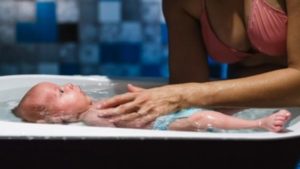
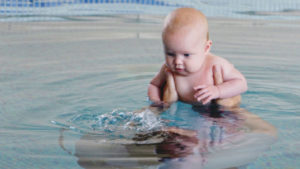
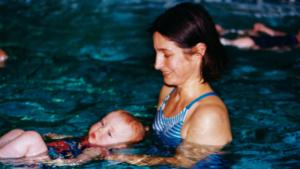
Aquatic Nurture provides the missing bridge between Aquanatal Yoga and Baby Swimming classes. As befits the ‘Fourth Trimester’, the first twelve weeks after birth, the focus is on Nurture, welcoming and cherishing the newborn in the world as a smooth transition from the womb’s fluid environment to gentle immersion in warm water. Birthlight practices are parent-baby interactive: trained instructors empower parents to transform the routine activity of “baby bath”, often associated with crying, into a pleasurable and enriching experience. Parents often benefit as much as their babies, relaxing together with them and seeing them without distraction as the exquisite little communicators they truly are.
Like all our Birthlight courses, the Birthlight Aquatic Nurture for Newborns course is founded in research from various disciplines. In the three decades since I have supported parents to enjoy ‘relaxed baby baths’ as a postnatal follow up (postnatal doulas were a novelty then), human fetuses and newborns are much better understood as extraordinary, complex beings. Their experiences are now known to matter for childhood and even for life. I have always been fascinated by newborns’ movements in water and I have used all available research to refine Aquatic Nurture practices in baby baths, in tubs and in small warm pools. Therapeutic baby baths developed by two pioneering French nursery nurses in maternity hospitals reveal the power of water associated with a specialist technique. Our remit, however, is to empower parents with their babies as much as possible. Techniques are transmitted for easy use in daily life, research is translated into simple practices.

Register for our upcoming Aquatic Nurture for Newborns

From personal practice and a spread in my Water Babies book (Anness, 1999) to a training course, several collaborations have supported the process: joined practice with Amanda Walker, demos in birthing pools during residential courses with Shawn Tomlinson and Sally Lomas and filming in the small pool at the Birthlight-Bright Family Centre in Moscow with Anna Shkulanova. Exchanges with Perrine Alliod, who coordinated the Paris photoshoot underpinning the illustration of our training manual, have been a sharing of knowledge and a delight. Thank you, Perrine! Finally, the manual formatted beautifully, with QR codes in place for clips, was ready for piloting in China.
It was exciting to be in Sunny’s Birthlight aquatic training centre Qing Dao, with tutor Judy Kou and ten new graduates willing to push the boundaries of baby swimming and explore alternatives to popular Baby Spas in shopping malls. Mothers can leave their babies floating in tanks with neck rings under the supervision of trained instructors who also offer baby massage (shiatsu style) after the bath. We all went to visit to one of those Baby Spas nearby and we were invited to demonstrate ‘the Birthlight way’ with three young babies. Two of the babies loved the holds and moves and the cameras were clicking all around capturing their relaxed supported floating. Involving the parents was the next step. The third baby, a two-month old little girl, arrived screaming and nothing could stop her. This is where the healing power of the water never fails when one really works with water and baby together. I asked her (in English) to tell me why she was crying so much as I gently lowered her in the tub. It was a trust exchange. Then she alternately pushed with her head and with her feet against the sides of the plexiglass tub with a strange energy. I got an insight that perhaps she had got stuck at birth and this was still bothering her. The two parents who were close to me, tense and exhausted looking, confirmed that she was born with an emergency C section after a long second stage of labour during which she got stuck. Since then, she cried and screamed. When she started smiling in the water, both parents melted. The mother lifted her and as soon as she was wrapped up in warm towels she fell into a deep angelic sleep. Both parents watched her for a long time with very tender faces. We had to go back to continue with the course but the memory of this instant birth healing in the water is still with me.
There is a lot of excellent research on the healing of birth trauma showing how babies and children ‘replay’ their birth scenarios with positive outcomes, undoing the obstacles they met during their births. The skills for this therapeutic service require special training in osteopathy, infant psychology and somatic disciplines. To my knowledge, there is no birth healing for babies in water. I do not mean to say that instructors certified in the Aqua Nurture course are trained in this capacity, far from it. But the wonder is that a healing release may happen spontaneously in a baby bath and this is a release for both babies and their parents. It can heal a new family. Premature babies can also heal their time at NICU in the home bath.

Ritual baby baths are practiced after birth in all cultures in many different ways, some are gentle, others are quite rough. I was lucky to witness the gentle parenting of Amazonian indigenous people, even if their care in keeping babies happy has more to do with preventing their souls from being captured by predator nature spirits attracted by baby crying… than with attachment parenting. With all our current neuroscience arguments, we can help parents to have the most wonderful and intimate experiences with their newborns, either in the privacy of their home or in small groups around a tub or a small warm pool.
Baby Swimming instructors are encouraged to do this course to support parents of new babies under four months booked on classes in their swim schools. Postnatal doulas, midwives, community paediatricians, health visitors and family nurses are all warmly welcome on this training along with other professionals supporting new families.
“Being immersed in another birthlight course reminded me the purity of baby swimming. Water can give a baby great power, water can give a baby unlimited possibility. I hope I can bring more babies to experience the wonderful birthlight water nurturing classes.” James
“I learned to respect baby, respect the track and progression of life. The joint water enjoyment enhanced parent-child relationship. Water gives baby an experience similar to that of an womb. Appropriate water temperature enables baby to enjoy and play with water current. Thousands of nerve receptors are stimulated and build better nerve connection network. In aqua nurture classes, teachers are just assistants in baby’s journey to be at ease in the water environment, learning to trust buoyancy.” Lizzie
“I had a new understanding on the significance of water to newborn. The water amplifies the sense of touching and hearing, and can lay the early foundation for happy, safe, and comfortable baby swimming activities with the parents later. Every baby founds his or her own way to explore and understand this world. We should teach parents to establish a water relationship with their babies as early as possible, so that water can be another parent for the baby.” Kevin Chang
“Birthlight Aqua Nurture course gave me an in-depth understand of what an infant needs emotionally and physically. Taking the course opened another door for me in the market. Even though the road ahead is still long and challenging, I have taken the first step. My skills in baby swimming and massage have advanced. I was particularly touched to see the happiness and contentment in the face of the parents of the demonstration families when they learned that they can establish a connection with their babies through water.” Wendy Wang
“The Aqua Nurture course helped us understand how to better utilize bathing time for newborns to enrich stimulation. We learned how to use different bathing equipment and setups to stimulate skin sensitivity before a child is old enough to join baby swimming classes. We also see how infant massage strokes differ between the West and the Chinese style.” Sunny Shan

From the start of Birthlight classes, the changing bodies of pregnant women who were mostly new to yoga called for a dynamic approach to stretching to make space for the growing babies inside. We used the breath, mostly the exhalation, to extend the muscles below, above and to the sides of the expanding uterus. We used fluid movements to avoid static held poses and their adaptations with props. We found micro-movements that helped to stretch hidden small muscles often not reached in regular yoga practice, particularly in the pelvis. By relaxed stretching, we meant going all the way to find the full extension of muscles without tensing (now we know that fascia tissues are also involved) and then to enjoy their full relaxation.

I, Françoise, learnt the experience of relaxed stretching from BKS Iyengar in London in the late 1970s. I can still hear him say: ‘tip of your middle fingers’. It changed my standing poses. I also remember watching him demonstrate Uttanasana, extending his crossed arms to the floor and then slowly further and further without apparent effort or tension. It was magical. From that day I started studying the anatomy of T12/L1-2, not just because I held tension there in my body but also because I felt this area where the thoracic diaphragm links up with the lumbar spine and the pelvis, was key to yoga asanas in the various planes.
We, Birthlight tutors and teachers, have conveyed the experience of relaxed stretching as interoception for many years with a simple practice of calm breathing in an aligned sitting position, with one raised arm held relaxed by someone standing behind the practising person. Without ‘doing’ anything else than breathing, the raised arm starts extending upwards on exhalations. The supporting person watches it happen and feels it. The sitting practitioner often experiences warmth, overall relaxation in the body and at times a feeling of peace and wellbeing from the spontaneous engagement of the parasympathetic mode of the nervous system. Long before the use of terms like ‘somatic yoga’ or ‘embodied’ yoga’, with this simple practice (as well as with various ‘grounding’ and earthing’ practices), we invited students to explore sensations and perceptions so that they could discover how to relate to gravity through the actions of the breath at a deeper level in their bodies. The teachings of Vanda Scaravelli supported this exploration.
Stretching has now a bad name in some yoga circles. Quite rightly so when it is done from the outside-in. But when it’s done from the inside-out, stretching is infinite and extends to all the five Koshas. Each person, each body, in their present life-phase, range of motion and flexibility (or lack of it) can discover the wonder of relaxed stretching – with the breath.

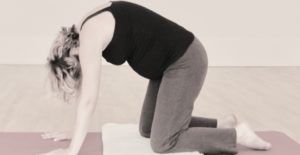
Stretching done in a relaxed way in the Birthlight yoga repertoire for pregnant women, new mothers and women wishing to focus on their feminine wellbeing is typically slow, done to the rhythm of one’s own breath -that lengthens in the process. Following Patanjali’s sutras, the activity needs to be comfortable and effortless in a steady position. We watch the facial muscles for hints of possible tension. Achievers are invited to explore thresholds, when pushing beyond the boundaries of one’s current range of motion is done with willpower/ego rather than allowing the body to yield in the extension. We do not have rules about holding: if the pose is comfortable and enjoyable and the breath is productive, why not hold it? This corresponds to the traditional teaching of yoga. If there is discomfort, flow and rhythm can be invited to ease the practice. The distinction currently made between static and dynamic forms of stretching melts in practice. Some of the birthlight hallmark practices, like ‘rolling cat’, are based on flow to avoid drawbacks of specific ‘held poses’: in the case of pregnant women or menopausal women, cow pose tends to aggravate a lumbar dip which can weaken the lower back rather than strengthen it. For women who do not have lumbar issues, the held ‘cat/cow’ practice may be perfect. Dynamic stretching, now included in warm up routines before sport activities, has been shown to reduce muscle strains, (but not to significantly prevent injuries), and to improve performance more than static stretching.1 Held stretches for more than 90 seconds, however, whether performed actively or passively with the help of straps, walls or another person, are now considered to be effective to help ‘repatterning’ the fascia collagen-rich tissues which may determine our body structure as they encase muscles.2
We do not pretend to have done it all before fancy new techniques and styles of exercising came into being. Yoga is so inclusive and wide-ranging in its resources and applications that we can keep drawing deep from its well of knowledge, both for practice and philosophy.

PNF (Proprioceptive Neuromuscular Facilitation) is an interesting concept because it fits well with our birthlight explorations around the pelvic muscles that support the female reproductive organs. Starting from Mula Bandha, we have designed ways of squeezing/tightening pelvic floor muscles singly or in opposition to one another, then relaxing fully to elongate, resulting in elasticity rather than mere toning. PNF focuses on the process of muscle squeezing to go further into a static stretch3. It is popular with physiotherapists because it is progressive, allowing a muscle to adapt to its new position each time it is held in position. Integrated within yoga, rather than taking a biomechanical approach to stretching, we see each muscle as connected with ALL the other muscles in the body through fascia lines.4 Stretching one set of muscles with breath awareness will inevitably lead to others, usually just those which the person needs to attend to at the time, resulting in an expansion of consciousness and wellbeing beyond improved flexibility and strength.
There are many entries on ‘relaxing stretch/yoga’ on the internet, with most practitioners advocating Yin Yoga or related practices. The focus is on stress release and/or workout for stiff muscles with some mentions of mindful breathing. We can keep referring to relaxed stretching as briefly presented above: a mode of gaining muscle elasticity with proprioception through the action of the breath as a bridge to the parasympathetic mode of the nervous system.
To conclude, whether static or dynamic, we need stretching to transform our relation to gravity that defines us as modern hominids, as our bodies change in time and age. Relaxed stretching is a conscious practice that involves our breath and nervous system and allows us to inhabit our bodies more fully. Our global culture places a high value on muscle tone but adverse effects of a sedentary lifestyle are widespread. Dynamic stretching and high muscle performance are pleasing, even addictive, but over-toning can be detrimental to long-term health and wellbeing. In yoga as breath and movement combined, reaching out to the deep muscles, both voluntary and involuntary, that house the central nervous system is an ancient and safe way to access the source of overall balance and joy of being.

Birthlight Tutor & Founder
Dr Françoise Freedman is the Founder and Director of Birthlight. She is a pioneer, Senior Yoga Teacher, acclaimed writer and lecturer of Social Anthropology at the University of Cambridge.
1 Opplert. J and N. Babault. 2017. Acute effects of dynamic stretching on muscle flexibility and performance: an analysis of the current literature’. Sports Medicine Vol 48(2):299-325.
2Findley T, Chaudhry H, Stecco A, Roman M. Fascia research–a narrative review. J Bodywork Movement Therapy. 2012 Jan;16(1):67-75
3 Hindle KB, Whitcomb TJ, Briggs WO, Hong J. Proprioceptive Neuromuscular Facilitation (PNF): Its Mechanisms and Effects on Range of Motion and Muscular Function. J Hum Kinet. 2012,Mar;31:105-13. doi: 10.2478/v10078-012-0011-y. Epub 2012 Apr 3. PMID: 23487249; PMCID: PMC3588663.
4 https://fasciaguide.com/experts/robert-schleip/
Copyright: Françoise Freedman & Birthlight

Birthlight Swimming classes aim to provide the optimum environment for not only learning to take place but to create deep emotional and loving connections between the parent and child. Water itself is a great conductor of emotions, it transmits both positive and negative intent and can set the tone of our classes. Our desire is facilitate communication and respect to our babies whilst building loving connections between our parents and babies. We do this by encouraging our parents to build relationships with their children in the water, to guide and observe their baby’s movements rather than TO DO for their babies. We champion a child-led approach, which will enable the child to discover their bouyancy, balance and breath in the aquatic environment over time.
This respectful relationship is also fostered in our engagement with submersions. A relaxed and happy parent and baby pair, will physiologically release both endorphins and oxytocin into their bodily systems, providing a chemical reaction that promotes love and bonding, a process that transcends the thought process. Our guidance in the delivery of elective submersions must also promote this chemical reaction, we must offer a CHOICE to the child to submerge or not. We should be allowing space and time within our lessons for dialogue between the dyad, the adult is the child’s partner and as such partner’s should work together. We need to educate our parents on the practice of elective submersions and move away from conditioning that offers no choice, acknowledging that baby/children can make choices from a very young age.
We are given a gift as Birthlight Teachers to develop a baby/child’s love of the water, creating synaptic connections that will last a lifetime if we acknowledge and respect their choices.
We need to educate our parents on the practice of elective submersions …
Francoise freedman
What we do in the water matters. Let’s help foster Magic Moments in the water, making positive memories for our wonderful families.
If you have any video footage or photos from your classes demonstrating Elective Submersions we would love to see them and how you are helping to spread the Birthlight message across the globe. Please post to our Birthlight Water Parenting Page.
Happy Swimming!!!
Extract from Birthlight Water Parenting DVD which is available to download on demand on Vimeo.
http://www.vimeo.com/ondemand/birthlightwaterparenting

Starts 17th October 2022: Special Edition Course to celebrate 30 years of Baby Swimming with Francoise Freedman

My baby-swimming journey started with the birth of my eldest daughter in 1975. I had some time between her birth and returning with her to my work in the Amazon. I needed to get her used to being in the water, crossing rivers with me and playing in the shallows with older children. I experimented with introducing her to water in our filled home bath aged three days: it did not work out. Then, I was reprimanded for swimming laps in backstroke in the fast lane with her on my front aged two weeks in the city pool. I am lucky not to have been sectioned. We continued our ‘water play’ in less public places. I never felt unsafe or threatening her safety.
Baby and toddler swimming have now reached a peak of popularity as a foundation for swimming that it is near impossible to imagine mainstream views and methods for teaching children how to swim then. Everywhere I turned, I got the same answer that there is no point trying before children’s fifth birthday. Luckily Miss Haddock, a Cambridge swimming teacher, offered to support me in securing my daughter’s swimming skills before we left for another long stay in the Amazon, when she was three. This time it was essential that she could swim confidently. I ordered an infant’s life jacket from Canada (a new concept) but I already knew that she would not be happy to wear this bright orange piece of kit when playing in water with local kids. By the time we left, she had basic water skills, that is, she could swim along the pool edge with a pole dangling in front of her. Hi 5! Her skills truly built up during another great year in the Amazon, with lots of ‘messing about in the river’ as people do daily. ‘Our’ river ran quite fast but there were safe shallows for women to wash clothes and children to play-swim. Small children help mums to catch armoured fish, crayfish, and other delicious water creatures, so diving is an early skill. There was always someone watching, and all activities were collective, with children helping younger ones.

I felt ready to welcome a small group of parents and babies to develop a gentle approach to water parenting
Back in the UK, I was attracted by the Russian pioneer Tjarkovsky’s passion for water and babies in water. But the freedom of swimming toddlers pictured in books and films about his method came at the cost of violent conditioning that seemed terribly wrong to me as a mother and as a person. It was contrary to our Amazon playful and relaxed experience. After my second daughter was born, I set out to achieve the same results in the UK, reproducing what I had lived and observed with her sister. After further experimenting with my two sons, who both swam early but with a completely different way of ‘surfacing to breathe’, I felt ready to welcome a small group of parents and babies to develop a gentle approach to water parenting, laying foundations of swimming. 1992 marked the transition to classes where parents were taught techniques while still having lots of fun. We continued to have family sessions with siblings of different ages.
In 2022, 30 years later, I feel we have come full circle after ‘baby swimming’ was developed as a thriving industry, with stereotyped one-fit-all type classes arranged in distinct age groups and mandatory practices. Sadly, these early water activities, that are often expensive, rarely lead to confident swimming skills. At age 4-5, or as part of school activities children join swimming-teaching classes in which there is little time for individual attention. In the aftermath of the Covid-19 lock down, a whole cohort of toddlers have missed out on early aquatic activities in pools. The time is right for a new start.
Early aquatic activities are well accepted in the global culture of parenting. We no longer need to fool parents with the illusion that their babies can ‘swim’ by showing them seductive underwater images. Everybody knows they are fake. But everybody also knows the health and development benefits of early aquatic activities, as demonstrated in research studies. Many parents love the special bonding experience that water allows with their babies. The right set of circumstances seem to be there to think again about the best formats that can give parents and babies together the best possible experience, while being financially viable for teachers and pool operators.
To me, water and feeling relaxed go together, and this starts with the first baby bath, the first entry in a warm pool. It has been a wonderful journey to discover that not only gentle methods work extremely well but also that they are best for enhancing the physical, mental and psychological development of babies. In the last two decades research in infant psychology and brain development has advanced at an unprecedented pace. We have access to a better understanding of how babies learn and grow and how different learning environments produce neuronal pathways that ‘shape’ babies’ brain configuration. The fast-developing research area of epigenetics probes deeper into the interface between inherited genetic traits and environment. The good news is that creating positive environments in which babies feel loved and nurtured has the potential to create cascades of long-ranging effects in children’s lives.
We can only ever teach when there is readiness, communication, and ease. Otherwise, we use forceful conditioning. Babies are very pliable, and we can bypass their resistance and screams through a process that infant psychologists call ‘habituation’. After repeated exposure to something that initially caused babies distress, they stop protesting and quietly submit in compliance. But this is DANGEROUS! By doing this, we have compromised communication, shutting off babies’ trust that we can perceive and understand their signals. We are going on a single sided journey of “do it my way, I am the adult, parent, teacher, the one with authority to make you feel competent or inadequate, so do it …” A lot of babies may not be affected; they might even emerge as stronger and performing better. They even learn to enjoy it because of loving to achieve or getting the rewards of pleasing parents and teacher. But the more sensitive babies may suffer adverse consequences in important ways that we are only just beginning to understand, at the roots of their self-esteem and ability to trust others, two foundations of human wellbeing and happiness.
To work with babies’ readiness, we need observation.

To work with babies’ readiness, we need observation. And because we are thrown at the deep end as parents (and baby swimming teachers) in experimenting with babies without a lot of previous experience with their kind, we need readiness ourselves to observe and respond appropriately to babies’ cues. AND, just as importantly, to parents’ cues. We really have three clients to look after: the baby, the parent, and the parent-baby pair as an interactive unit. Multiply this by 8! We are dealing with a crowd and need serious shortcuts to address all the different needs collectively –to create a happy learning environment- and individually, to offer individual attention and nurture. How is it possible to acquire such complex interpersonal sensitivity without years of teaching experience? At Birthlight, we have a passion for translating research findings into simple practices that help teachers in the water relate more directly, efficiently, and positively with parent-baby pairs. In 30 years, foundation practices have been developed, refined, and streamlined, but the early ways of teaching inspired by Amazonian indigenous people remain fully valid. In fact, some compromises and imported techniques included along the way can now be lifted. I am grateful to all the Birthlight tutors and teachers who have shared their knowledge, experience and wisdom along my baby swimming teaching journey, that I have never perceived as an individual one. There is a wonderful worldwide collective of pioneer seniors and younger teachers whose connections are strong and directed to a better future of ‘baby swimming’ as both aquatic early education and foundations of lifelong swimming.
Ideally, babies start their introduction to water before birth, feeling the relaxed aquanatal moves of their mums. But whatever the age of babies on their first water class, it is important for teachers to know how to assess which practices are going to work best for them. The understanding of cues, reflexes, body language, use of voice and word choice are all part of teachers’ equipment, just as important as the floating aids we may use.

In all our practices, the element of communication is dominant: is the parent learning from the baby and responding to what the baby is trying to say? Rapidly, babies feel understood, beam to the parents and the parents start feeling on top of the world. We have then created an expanding spiral of enjoyable learning and a love of being together in water. Swimming is already programmed in the natural joy of free movement that infants experience. Submersion can be introduced in a relaxed way as part of flowing moves. The more spontaneously it is done as part of the supported confidence to move freely that babies have gained from ‘relaxed holds’ and their extensions in parents’ arms, the more babies find the self-propelling moves that can save lives if they fall in water. Rather than water-training babies by repeated submersions or sustained back-floating, we encourage them to move freely in the water, each in their own way and at their own pace. In this way, water teaches us parenting.

The paramount lesson of the water is respect. Even a shallow pool reminds us that as much as we can feel at home in the water, we need to adapt to this element to float and breathe. Babies encouraged to move freely and surface to breathe at their own pace will not be foolhardy in water because they have experienced their limitations directly without the false security of buoyancy aids. Gentle ways are conducive to respect, in contrast with drown proofing methods that induce the perception that water is to be feared and dominated. Correcting faulty body balance developed from this attitude to water is hard work, which is best avoided.
Personally, I love technique, achievement, and excellence in performance. The radiant face of a tot who manages to swim a few metres into his or her parent’s open arms is a great joy for me. But getting a timid baby to jump from the pool wall without holding a parent’s little finger can also be a triumph. Helping parents to unlock their babies’ potential in an active, body-based dialogue with them in water, with total acceptance, is magical. Let’s not miss out by dumbing down these brainy creatures by pretending to control them when they can best unlock their parents’ teaching skills, and our potential as swimming teachers, through heartfelt communication and movement together in water.
The Birthlight Advanced course offers further techniques and moves that liberate parents from drown proofing babies or teaching them to swim while making these goals achievable.
Francoise freedman on the birthlight baby swimming
The STA parent and child course derived from Birthlight has touched many people’s lives and it has set up a happy foundation for early swimming and water safety skills in the many parts of the world. As baby swim schools and trainings have proliferated, babies who swim independently still make news but most parents have realised that their time in the pool with little ones has a special quality that no land-based activity can equal. The Birthlight Advanced course offers further techniques and moves that liberate parents from drown proofing babies or teaching them to swim while making these goals achievable. For Amazon rainforest people, swimming is an essential skill that is transferred in two stages and two forms: first, babies and toddlers enjoy being moved in shallow water around their parents at bath time and this has been the inspiration of the ‘relaxed hold’ practices we teach. Then children rather than parents are put in charge of getting little ones to independent swimming. Children are mostly patient and responsible but also very direct using dynamic modelling and minimal support that their younger siblings enjoy and respond to. Watching them has been an inspiration for the Birthlight moves to facilitate transitions from holds to independent swimming.
Françoise Freedman
Starts 20th July 2022 with Françoise Freedman

The fertility journey can be an emotional roller coaster. When women come into the yoga space for a fertility workshop there is usually a mixed feel in the room. As a teacher I’m aware that fertility yoga is not a celebration, like pregnancy yoga can be, nor should it be full of promises or outcome focused. As yoga teachers cannot guarantee conception post yoga, no-one can
Indeed the coming of babies is in the hands of the Gods is it not? But does that mean there is nothing to be done? Surely not?
In an ideal world the most useful thing I could have for my fertility clients would be a crystal ball. If I could say to a woman, this time next year or you’ll be in my pregnancy classes but not until Christmas. Oh imagine the level of relaxation that could come, the smiles, the joy, the feeling of relief. As women we just want to know.
We don’t have crystal balls. We can’t bring that level of relief.

But what we do have are ancient yogic practices that can improve our physical health, our mental health and deepen an awareness of a spiritual connection to a higher power… if we let it, our yoga does this work, not necessarily our words.
My fertility workshops often start with a feeling of anxiety or apprehension in the room. Women often carrying the thoughts, will this work? What if it doesn’t? Am I being silly even trying this?
As we work through a fertility practice we move away from the thoughts of pregnancy or not pregnancy and we do what we do as Birthlight teachers. We help women connect with their bodies.
A few minutes of deep yoga breath and women are down into their bellies. They start to soften and breathe deeper and we make our way, together as a class, into the present. This is a powerful place to be. Gone are the stories, the what ifs, the ‘maybe next month’ thoughts and feelings and we sit with the ‘right here, right now’. We have an awful lot of our personal power available to us in the ‘right here, right now.
I work with shoulder openers, hip openers and this is deep work. Hidden tensions and pains can emerge but often they are released with the breath. Women soften before my eyes. Nowhere else to be but here. Improving oxygen levels, raising energy, improving pelvic health by increasing blood circulation and simply opening the hips. Many women have sat for 20 years with their legs crossed daily on an office chair and to undo that level of postural misalignment and tension is wonderful!
The HPA axis is a big deal in our culture, caffeine, dead lines, the pushing of young women towards education and career success often comes with the unspoken expectation that they will override their personal needs, ignore the cycles of their bodies and push harder into stress until it’s simply a way of life. Burn out is a common phrase in this generation.
This is where our work lies, in the undoing of the cultural norm of high stress and in my experience its simple, we start with the breath.
I share stories of great yogis who proved the mind body connection. I bring awareness to the reproductive system and with gentle guided meditation we connect with the womb. The womb, a power centre, a centre for creative brilliance and cosmic wonder is so often ignored on the fertility journey because so much is going on in the head but also because as women it can be where we hold our pain.

Breath work for relaxation, long held anxieties and tensions that often exist not just from the past but because a woman is in a constant state of uncertainty, can be released. Deep relaxation in a fertility workshop can be very deep. Undoing often years of held tension and worry can take a woman into a healing space.
We can’t guarantee a future, no immaculate conceptions have ever happened in my fertility workshops but we can bring women into deep peace in the present. There is a subtle difference between living in the future, constantly being elsewhere, and being deeply present with hope.
Hope is the part of us that refuses to give into despair and hope is always available to all of us. Some women resist hope because they feel it sets them up for disappointment but I feel there is medicine in hope and it can be weaved subtly into our fertility classes as guide women settle into their power of the present moment.
The feeling in the room at the end of a fertility workshop is always the same. There is warmth, openness, big smiles and more energy. There is hope and a new way forward that includes self care, self nourishment and self love. Medicine for these times indeed.
Thank you to Francoise who taught me fertility yoga and on behalf of all of my women who have benefited both those who became pregnant and those who have not (yet?), I am really grateful for your wisdom and huge kind heart which shines through all of your work. Thank you Birthlight.

Pregnancy Yoga Instructor
I work with fertility clients in yoga workshops and I work 121 with nutrition. Fertility yoga can be so much more effective when a woman is deeply nourished by the food she eats. I am a nutritional therapist and back in 2014 I worked with Dutch fertility expert Rika Lukac on her book Eat, Breathe, Conceive. This book looks at how to lower stress with yoga and nutrition to support the body into pregnancy. We need certain raw ingredients to get pregnant and stay pregnant. But a body in high stress is less able to absorb vitamins and minerals, a dehydrated body even less so. I recommend this book to all my clients and I would highly recommend it to fertility yoga teachers. Its available to buy from my website www.yogabumpsandbabies.co.uk/shop

Book a Course

Baby massage has been around for hundreds of years, from ancient India, to China, Africa, South East Asia and around the globe. Indeed, I suspect that parents have been lovingly stroking their babies forever. Whilst baby massage classes are a relatively new trend for the western world (classes in the UK started in the ’80s), it is increasingly becoming a popular activity for new parents to undertake in the early weeks of caring for infants. So what’s all the fuss about? Why is baby massage so helpful?

Baby massage helps babies to sleep, digest and feel good
It’s becoming more and more well known that skin to skin is the best possible start for babies when they are born. This direct contact with Mum’s body after birth helps to regulates baby’s heartbeat and breathing. It helps babies adjust to the sudden experience of the bright noisy world outside the womb.
These benefits don’t end a few hours after birth though. Skin to skin contact continues to be a reassuring and physically regulating experience for babies and children throughout the early years. Sleeping, feeding and crying are often the main concerns of new parents and baby massage helps them all! When we lovingly and respectfully massage our babies, we lower their stress hormones, stimulate their digestion, and help them to release tension, resulting in happier, calmer babies. If you’ve ever had a massage yourself, remember how great you feel afterwards. How good your body feels, how much better you sleep. Now imagine that you’re in a new unfamiliar environment and your days are filled with endlessly learning multiple new things whilst not speaking the language. And then imagine coming into a quiet calm space and your most loved and special person gives you a loving massage. Bliss.

Baby massage helps parents’ sleep, digest and feel good
Birthlight baby massage stands out from other classes as we integrate postnatal yoga and nurture into each class. We teach gentle and effective stretches for mothers that are suitable right from birth, helping to heal, gently strengthen and align the body. We also enjoy a shared relaxation with the babies at the end of each class, and mothers and babies very quickly learn to enjoy this quiet and restful cuddling time. By engaging in these safe and effective yoga practices we lower our stress hormones and release tension held in the body and the mind.
One of the Birthlight principles is to ‘mother the mother’, providing a nurturing space in which we can take time to digest our birth experiences. The transition to parenthood can be a steep learning curve, and taking time to let all these new bodily and psychological experiences settle helps us to be more resilient and less stressed. Babies require a lot of intense caring and by looking after ourselves, we in turn, are more able to find the patience and creativity needed to care for our little ones.

Baby massage helps you learn to speak your baby’s language
So many of the trickier moments of new parenthood are about staring at your little one thinking- What? What is it? Hungry? Tired? Bored? Cold? Hot? What’s wrong? What do I do? How do I make you feel better?
One of the lovely things about taking the time to spend quality one to one time with your baby, massaging them and interacting with them is that we learn to speak their language. We become attuned to this other tiny person, so that we begin to recognise their facial expressions, their body language and the different tones of crying. We start to feel that we know what to do, without necessarily having to think it all through, but just through following our parenting instincts, our gut feelings. One of the benefits of doing this in a class setting is that you have a teacher to guide you – to point out some of the ways we read baby cues. We also have the opportunity to learn from the others in the class, seeing how other babies react, and especially seeing babies a little older than our own, so that we see what we may expect in the weeks to come.

Baby massage creates a wonderful social bonding space
There is really something special about being welcomed into a warm nurturing space when you have a little baby. Somewhere you know you show up joyful, full of new parent excitement, or feeling wretched, tired and emotional, or anywhere in between. You can show up with a baby crying or sleeping, you can feed or walk your baby around the room. You can be just however you are, and you can relax into the feeling that there are no expectations on you or your baby. It’s so good to know that you will be with others going through their own version of this same journey.
The peer support networks we create in these times can be hugely helpful. Birthlight baby massage classes, and in fact, all our classes, are taught in a circle, where we learn together, and we share the joy and difficulties of parenting. This sharing creates friendships that spill out of the classes and can cement into peer support social circles. With 1 in 10 women in the UK now experiencing postnatal depression, we know that these classes and friendships are crucial for new mothers. They help us to avoid or mitigate feelings of isolation and loneliness, helping us to relax into the joyful moments, and to weather the difficult ones.

Baby massage encourages ‘Spirals of Joy’
There is a wonderful event that happens when babies and their carers become well attuned, a magical mutually profound moment of joy. Perhaps it starts with the baby making a coo-ing noise. The parent then leans in close, makes eye contact and coos back with raised eyebrows, starting a conversation. Connecting into the parent’s invitation, the baby smiles, coos and makes happy little leg movements for a moment, before becoming still again, waiting for the response. The parent cannot help but smile back, and so the spiral continues. These moments may be sweet, but they also serve an important function. We are tuning into a deep communication with our babies. We are raising our own and our babies’ oxytocin levels (the wonderful hormone of bonding, love and trust), which both deepens our bond, and helps us to feel good. It’s like nature’s reward for the commitment of parenting. These oxytocin fuelled rushes of pleasure simultaneously help us to feel better, and to be closer to our little ones.
Perhaps the loveliest thing about Birthlight nurturing baby massage classes is that these spirals don’t just affect one parent and baby. They spiral out into the classroom, into the wider families and out into the community. Have you ever smiled and felt a little taste of joy when you see a cute baby and parent interacting? Congratulations – you just got included in the spiral. It is amazing how much joy a close bond between a parent and child can bring to the world.
“I’m absolutely loving teaching baby massage. My classes are busy and all the women and babies love the classes. The room usually feels awash with oxytocin. I’m also loving massaging my children too. Both my 3 and 12 year old love having a massage now and it is becoming such a useful parenting tool when they are feeling vulnerable and like they need to connect but aren’t sure how to with words. Particularly with my 12 year old. She always talks to me about her life when I massage her and it’s brought us closer together again, like when she was little. Your course has brought much light into my life, so my deep thanks for that.”
Graduate, birthlight baby yoga & Massage
See below about our upcoming teacher training course in Baby Massage & Baby Yoga Teacher Training.

Birthlight Baby Massage, Baby Yoga & Toddler Yoga Tutor
Since 2014, she has been training teachers for Birthlight across the globe which she regards as a privilege. Bryony is a birth and postnatal doula and also teaches classes in Cambridge from Pregnancy through to the Early Years.

Birthlight Nurturing Baby Massage & Baby Yoga 1 Teacher Training
Next course intensive in June over 2 weekends
If you’ve already trained in baby Yoga with us you can join just the massage part of this training!

I began my Perinatal Yoga Diploma with Birthlight in 2017 when I was in the 2nd trimester with my son and began teaching other pregnant women from my 7th month of pregnancy and was able to complete the full course work once my son was born and became a toddler. I am now in my fifth year of teaching this specialisation and it’s been such an incredible journey!
Since completing my training with Birthlight, I’ve moved from teaching in a local community hall, to teaching privately in people’s homes, in local studios and now running hybrid prenatal yoga courses from my very own garden yoga studio in Ealing.
For me, it’s about creating a safe space for women to feel supported during their pregnancy and postpartum period. To ask questions and get tailored advice, to learn about birth ecology in an empowered way, and to understand that they can give birth on their terms, with informed consent.
How women respond to these classes

As a yoga and birth preparation guide, the most rewarding thing to hear is that your students have actually used the tools that you’ve suggested outside of a class, course or workshop the yoga studio or an online class. Pregnancy yoga classes and birth preparation workshops are rewarding containers. I feel blessed to be in a position to hold space and where women often share the details of their birth experiences with me – what tools they used and how it helped them to stay calm and create a more stress-free environment. No matter which direction their birth takes, these women have felt empowered to use pranayama breathing techniques, positioning postures and other tips I have shared with them, and been able to find trust in the strength of their bodies. Such an honour!
And so can you! As a Birthlight student, you have the power to create that too!
Imagine meeting the babies of the women you have supported, receiving a message from a woman that you have guided to thank you for the time she spent in your classes when her baby is only a few days old? To have the absolute trust of women during one of the most mentally and physically challenging, yet beautiful, times in their life.
To know that you’ve helped women have a better experience of birth the second time around than they did the first, before they worked with you.
It is an amazing feeling. Rewarding spirals of joy keep on flowing from the Birthlight well! To prospective, new and current yoga teachers looking to deepen their offerings. I challenge you to serve. How can you better serve your community? How do your interests, specialities, and experiences align with what could support the members of your community and the people attending your classes?
How we can continue to support women moving forwards
Together, we have the power to create enormous change. But it takes every single one of us to see the change we so desperately need.

In the UK, Women of Colour are 5 times more likely to die during pregnancy and following birth than Caucasian women. “The inequalities observed in previous reports remain. Black women still have more than five times the risk of dying in pregnancy or up to six weeks postpartum compared to white women, women of mixed ethnicity three times the risk and Asian women almost twice the risk.” *
This is a painful reality that many practitioners, teachers, and mothers are unaware of.
We need to create inclusive environments that welcome all women and all birthing people. At least that way, we can equip women, no matter their race, with the knowledge they need to speak up about their experience of pregnancy and birth, and with the tools to help them stay relaxed during labour and childbirth.

Research has shown that women who are more relaxed (thus less stressed) are more likely to experience shorter labours and overall better births. And as yoga teachers, we have the power and the resources to help equip them with the tools they need for a more relaxed birth, no matter what happens. To teach them the skills they need to avoid stress throughout their experience. To know that they are supported and that we truly care about their welfare.
This is how we can really start improving lives from the womb going forwards. By supporting women. By being inclusive. And by remembering the self-confidence that we can help these women to create.
One thing that I offer at Bija Garden – and that has been really effective – is offering a sliding scale for participants, where possible. Those that can afford it have the choice to pay a little bit more that will then, in turn, allow a free space to be offered to someone who would otherwise be unable to attend for financial reasons. This is one thing that I would encourage all yoga teachers to consider adding to their classes.
It’s also important that we’re obvious about the inclusivity of our environments.
This comes down to seemingly basic things such as the skin colour of the emojis we use, the words that we use in our marketing, and making a point of including people of all genders, culture, and race in our class photos where possible.

Birthlight Trained Yoga Teacher
Tzaddi is an Artist, Yoga Teacher, Producer and Spiritual Guide from London with over a decade of Yoga experience. Her background in Arts & entertainment helped her define her body as an instrument, and her journey with yoga has helped her appreciate and refine herself as a vessel, in a truly holistic sense. Tzaddi trained in Birthlight Perinatal Yoga in 2017 and holds many other qualifications.
Upcoming courses: April in Belfast / November in Zurich

“The more we do our yoga, our yoga, our yoga, the more we do our yoga the healthier we’ll be. We’re bendy and stretchy and peaceful and happy. The more we do our yoga, the healthier we’ll be.” I sing this song regularly in my Yoga Babies classes, but the more I teach and the more I practice the more I realize just how amazing yoga truly is.
“The more we do our yoga, our yoga, our yoga, the more we do our yoga the healthier we’ll be. We’re bendy and stretchy and peaceful and happy. The more we do our yoga, the healthier we’ll be.”
song sung in “yoga babies” classes with sarah brannen
When I first came to yoga during University I was attracted mainly by the physical aspect. I had danced throughout my childhood and found the flowing vinyasa style yoga gave me that same happiness I had felt whilst dancing. I loved finding the connection to my body again, loved moving and stretching with a rhythm all my own. Surprisingly though I also came to love the mental aspects of my yoga class. By bringing my awareness to my breath and my natural rhythms through the class I was able to tune out some of the stresses of life. My head was rarely quiet, except for those few minutes at the end of my yoga practice. Once I started practicing yoga I felt stronger, fitter, more flexible, but most importantly I felt more at peace with myself.
I continued going to yoga classes weekly until my first daughter arrived in 2011, by this point yoga was a part of my life and I was keen to get back on the mat. Finding nothing locally, I bought Tara Lee’s DVD, “Yoga for You and Your Baby” and started to explore the wonders of baby yoga. I had thought doing yoga with my baby might be a gentle way to reconnect with my body, start to regain strength and stability, find some balance. What I found once again was so much more. Yoga with your baby is the most amazing bonding experience. It is time without distractions, without expectations. The only thing that matters is enjoying the time with your baby. Whenever we got to that time in the afternoon when we were both exhausted, but it was not yet time for bath and bed, I would put on the DVD. It would take us both from stressed and grumpy to giggling, happy and relaxed. I did start to feel fitter and stronger again, but more importantly I accepted where my body was right then, and appreciated the changes and the little person who had made those changes. My daughter became flexible, stronger, more coordinated but more importantly she felt safe and secure.

I trained with Birthlight in 2013 to teach baby yoga, since then I have continued my training to include toddler, childrens and family classes. I also completed my 200hr training in 2017. During my training we talked about the many benefits of yoga for all the different ages. There are so many physical benefits, it would encompass a whole other post. Baby yoga is fantastic for helping the digestive system and encourages brain development. Toddler yoga improves balance and helps develop fine and gross motor skills. Children’s yoga promotes flexibility and body awareness. But yoga is about so much more.

When we practice yoga together, especially in classes with our children and with our families, we are building communities. We find ways to connect with each other through touch, through play, through songs and movement. In my classes I get some amazing opportunities. I watch new mothers develop confidence as they start to realize that they have all the tools that they need to keep their baby happy and healthy. I see parents with toddlers who are testing boundaries reconnect with one another as they cuddle, laugh and play. I see groups of children working together, smiling together, bonding as a group. I see families share their thoughts and dreams, see them lie together and relax. I am privileged to be able to see the special smiles, the eye contact, the little touches, the hand holding, the hugs and kisses, the whispered words. So yes, most of my little yogis can touch their toes, they can even touch their toes to their nose, (so can many of my yoga parents!) but that’s not the most amazing thing. Yoga is helping them to feel secure, to feel safe and loved. Yoga is building a community for new parents where they can share their experiences with others in similar situations. Yoga is giving families tools to have fun together and to connect with one another. And that is truly amazing.
The moves and sequences used with the babies in yoga classes are specifically designed to help baby’s development. The stretches can help babies to build strength and flexibility. Working both sides of the body stimulates the nervous system and can help develop conncetions in the brain. Songs and rhymes stimulate babies and links have been made between early learning of nursery rhymes and later reading skills. Providing time in close contact with an adult carer helps babies to feel safe and secure, aiding their healthy emotional development.
Early communication happens long before babies can speak, or even gesture. Very young children will use eye contact, facial expression and movement to communicate with their adult carers. Touch is one of the earliest forms of communication, and many studies have been done to show that positive touch in the early years is essential to healthy development. In yoga babies classes we use lots of positive touch, and spend time watching babies closely, which can help parents to tune into their baby’s needs and recognise their emotions.
Parents often find that they hold a lot of tension in their shoulders and upper back. The stretches I incorporate for adults in yoga babies classes target these areas particularly to help create space and release tightness. Lower back pain is another common complaint, due to weakened abdominals and lots of time carrying and holding babies (and their equipment!). The gentle yoga sequences in class can help ease pain in the lower back, and will also slowly help you regain strength and stability in the core and the pelvis. We also look at different ways to pick up, lift and hold your little one, with tips for how to do these actions most comfortably.
Adjusting to life as a parent can leave you feeling isolated, anxious and unsure. One of the most valuable things about attending a class, is having the opportunity to share experiences with others. Realising that there are other people feeling and going through exactly the same as you can be immensely reassuring. And even if there is no magic cure to the 4 month sleep regression, no perfect routine that will work for every baby, it is helpful just to hear stories from others in the same boat (or in this case maybe the same haze of sleep deprivation, exhaustion and doubt).
I have brought my own children along to classes, and aim to provide a relaxed place to be. You are welcome to feed your baby, change them, and there is no pressure to join in with everything. I encourage parents to follow their own needs and those of their baby’s. I do not expect babies to follow a plan, follow instructions, or be silent for any length of time!

Yoga Teacher
Sarah Brannen is a yoga teacher and family yoga teacher based in St Andrews, Fife. She helps people of all ages to practice yoga together so they can feel healthier and happier. Sarah has Birthlight certifications in Baby Yoga and Toddler Yoga.
Contact Sarah:

Become a Birthlight Baby Yoga Teacher by taking a Birthlight certification course …

As a Swim teacher and a Yoga Teacher for the past 20+ yrs, when I found Birthlight it was like winning the lottery. Being a part of this community allows me to teach and tutor Aqua natal, and Baby Swim in the holistic Birthlight way.
As a practice for preparation for birth, Aqua Natal is right up there. From the research about benefits to both Mum and Baby to the strong connections Mums make with other Mums and babies in the medium of water. The support is womb like.

Water is used therapeutically in many rituals all around the world and I am still in awe with the joy women get from Aqua Natal exercises. Releasing themselves from the full force of gravity, enjoying the pleasant feeling of lightness, moving with greater ease of movement and enhancing cardio fitness.was done.

One of my most memorable classes was when a Mum who was full term (but waters hadn’t broken yet) came to my class as she just wanted to be in “her tribe” where she felt “safe”. At relaxation she requested deep water and noodles to practice forward holds, and by the end of relaxation she was in labour! Without fuss ALL the women got dressed and we all waddled over en masse to the maternity unit 10 minutes walk away. The love, empowerment, and strength flowed freely that day with a beautiful baby girl before the day was done.

I have taught in many pools in different countries but my favourite has to be, being outdoors in the foothills in Majorca with pregnant women and teachers enjoying the warming sunshine on our bodies and souls. Most of my Aquanatal Mums come back to me with baby for ” Baby Bubbles” Parent and baby classes, from 0 – 36 months it’s like a wee family but huge.
I hope you will join us in experiencing these delightful moments together.
(hover to pause carousel)
Thank you Gill for sharing wellbeing through the enjoyment of water and aquayoga to so many pregnant women and new families. Having you on board as a Birthlight tutor is very special. The feelings your pictures convey are like stardust, inspiring and showing the warmth and love that is so needed around pregnancy, birth and beyond. Françoise
Francoise Freedman, Birthlight Founder

Aqua Yoga and Swim Teacher (20+ years) / Birthlight Tutor in Aqua Yoga & Baby Swimming
Combining her swimming teaching and coaching experience with exploration of innovative body based practices to support motherhood in Aqua Natal yoga, Aqua Yoga Therapy and Baby Swim. In 2018 Gill expanded into tutoring for Birthlight. So, along with working weekly classes as a swimteacher and Pregnancy Yoga Teacher in Belfast, Gill has lectured and taught in China and Russia whilst running regular training in the UK and Ireland which has inspired her to deepen her knowledge in all aspects of pregnancy, birth and beyond.

Join Gill in March in Northern Ireland for this training course

In July 2020 I trained to teach Toddler Yoga with Birthlight. I have been teaching baby massage and baby yoga for the past 10 years and wanted to expand this valuable work to parents and young children. I have also worked as a Speech and Language Therapist for 18 years providing therapy and support for children and their parents. The Birthlight toddler yoga course, delivered online by Emma Philip, was inspiring and it reignited a thought that I had when I did my baby yoga training: the power of parent and child yoga to develop children’s communication skills.
The more toddler yoga classes I run, the more I am seeing the impact they can have. The diagram below illustrates the many areas that my parent and toddler yoga classes support.

We know that the early years are critical for children’s development
helen guntrip, Specialist Speech and Language Therapist
The children attending my classes, at the moment, are aged been between 18 months and 2.5 years. We know that the early years are critical for children’s development, especially their language and communication skills. My classes are repetitive. I find that young children like the familiarity of routine. It helps them to settle and feel at ease as there is a predictability to each class. Children need to hear words several times to enable them to remember them and then say them. Rather than having a different theme each week I cover similar vocabulary in every class: greetings, animals, transport, body parts, action words (jump, sleep, roll), position words (up, down, under, forwards), weather, colours, words linked to feelings. I vary the activities slightly from week to week but the structure of the class remains the same: A welcome song, a warm up, various songs and activities, relaxation and a goodbye song at the end. Parents have commented that their children are now using new words that they have heard in the class.
There is no pressure on the children to speak or say words. Some children love to join in verbally, others prefer to just join in with the movements. To develop their understanding of words, children benefit from hearing words related to what they are doing rather than being asked questions. My experience of working with children with communication difficulties makes me conscious to ensure that all children can understand and participate. I therefore use a range of visual support including, pictures, gestures, signs, objects and facial expression. Every activity has a picture or an object to represent it. I keep my language simple and at a level appropriate for the group, differentiating for each child if needed.
From birth, babies are developing their ability to hear and make sounds. Toddler Yoga encourages both parents and children to have fun playing with sounds and simultaneously the breath. Children experience different types of exhalations as they move into various animal poses – from the deep roaring of the lion to the high frequency hissing of the snake. They may feel the calming effect the elongated ‘shhhh’ exhalation when we curl up for ‘sleeping bunnies’ or the vibration of the ‘zzzzz’ of the bee. They enjoy joining in with the ‘ch ch ch’ of the train going down the track as they bounce up and down on parents’ laps. The children love to make the sounds – no-one cares whether they are correctly pronounced, the children are just watching their parent’s mouths and faces and imitating. As children get older we can explore the breath more, but playing with sounds is the perfect introduction. Making and listening to sounds is the foundation for speaking.

Children need to move and they learn through movement. Toddler yoga enables them to develop their gross motor skills, body awareness, balance and co-ordination. Some toddlers have missed out the crawling stage, moving straight to walking. Toddler yoga gives children the opportunity to crawl, enabling them to benefit from integrating and co-ordinating both sides of the body. Repetitive movement such as clapping, tapping, marching, jumping and rolling can be regulating for children. Babies hear the rhythmic beat of their mother’s heart in the womb and are soothed by being rocked. Toddlers can also find this type of movement settling and calming. Through toddler yoga parents become aware of the movements that calm or energise their children (this will be different for every child) they can use these movements to help their child if they are low in energy or need calming. When children are having fun moving their bodies they are focused in the moment and hear the language to match their actions at the same time.
Singing and music relaxes us, it releases oxytocin, extends our exhalation, and makes us feel calm. Songs and rhymes are so important for language development. The repetition of songs supports children’s listening and vocabulary skills. Action songs, especially those with a parent such as ‘row the boat’, are fun and provide the opportunity for shared movement, touch and interaction. When singing we tend to slow our pace down, enabling children to hear the rhythm and rhyme, all of which supports those crucial foundation skills for speaking, listening and ultimately reading and writing.
Emotional regulation is our ability to recognise how we are feeling and develop ways to manage this. Children of all ages, and many adults, need to have someone to help us and co-regulate. Having taught baby massage and baby yoga for many years, I emphasise the importance of my classes being baby led and encourage parents to notice their babies cues and respond to them. I apply the same philosophy to my toddler yoga classes. Parents and children know that all emotions are welcome, crying is ok, feeling anxious is ok, getting really excited is ok. The yoga mat provides an individual space for each parent and child to share. As long as the children are safe they are welcome to move away from their mat, the group and activities for as long as they need to. I encourage parents to allow children to sit on their laps or have a cuddle if they are seeking a moment of connection or reassurance. In the same way that we don’t massage a baby when they are not in the mood, I encourage parents to read their toddlers cues and allow them to join in when they are ready. With no pressure to join in, parents can relax, breathe and enjoy the classes rather than trying to persuade their child to be doing the expected thing.
I really didn’t believe this could happen! At the end of each class, I dim the lights and give a glitter tube to each child full of stars for them to watch. I always do the same thing and have found that, once the lights go down, they return to sitting on their mats with their parents. Some cuddle up, some sit up, others lie down and they listen to me recounting all the amazing things they have done in the class. We then listen to a song together to end the session.

I love seeing the interaction between parents and their children during the classes. The shared movements, songs and rhymes enable parents to give their children their full attention, be present in the moment and develop their communication skills at the same time. From the poses to the relaxation, there are no expectations for parent or child, there is no ‘right’ way to be. I hope that my classes provide a break away from the pressures of parenting, a time to connect together without judgement. I make sure that all activities are easy to replicate at home and provide parents with a playlist of songs.
So that gut feeling I had during both Birthlight baby and toddler yoga training is now becoming a reality as I am seeing positive changes week by week in the children coming to classes. I would love to be able to prove this impact through research, although I’m not sure if it can be quantified. The simplicity of a shared song, a time to move together, positive touch and interaction -that is the power of toddler yoga!

Helen Guntrip is a Certified Infant Massage Instructor with the International Association of Infant Massage (IAIM), and a Birthlight Baby and Toddler Yoga teacher. She is also a Specialist Speech and Language Therapist.
You can reach Helen and sign up for her classes via her social media channels:

Train with Birthlight to be a Toddler Yoga Instructor – course in January 2022