#BabyCommunicationWeek23 #AmazedByBabies #brazeltonuk
Wednesday – Brazelton Baby Communication week: co-learning baby sleep in joint relaxation
Textbooks assert that newborns can sleep as much as twenty hours in a 24h cycle. This is rarely what new parents experience, even though their babies’ crying may mislead their perception of time spent asleep. Active sleep is crucial for the rapid post-natal brain growth of human infants, with frequent waking not only during the day but also at night before circadian rhythms develop. A recent study of sleep spindles, a type of brain wave important for transferring information from the short-term memory area, the hippocampus, to the long-term memory areas in the cortex, shows their most intense development in the first four months of life.
Since the early weeks and months are also a time of intense experimentation for new parents unfamiliar with baby care, it is crucial to provide them with practical resources to encourage newborns’ best possible sleep. The staggeringly high number of sites offering advice about baby sleep shows that this is a major concern: new electronic monitors, automatic rocking cradles, elaborate sleep charts vie to help parents establish some form of control in their lives with newborns who do not sleep easily.
Berry Brazelton’s identification of babies’ six ‘states of alertness’ greatly facilitates the perception of differences between light sleep and deep sleep. Intermediate states, such as ‘drowsy’, and ‘alert fussy’ draw attention to babies’ behaviours when tired. These are the transitions that caregivers need most practical help with to learn not only babies’ generic body language but also how to address the needs of individual babies.
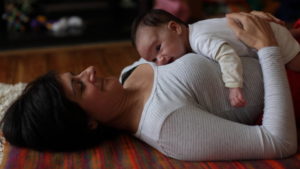
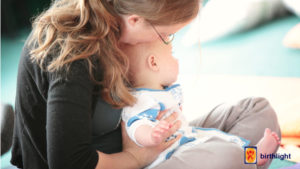
Rather than co-sleeping (but not excluding it), joint relaxation is a matter of releasing body tension while lying down close to one’s baby, ideally starting to practise when the baby is in a sleeping or drowsy state
Coaxing babies to sleep with lullabies and rocking rhythms is an activity as old as humanity and makes for rich cultural traditions. In the Amazon region, baby slings that double as baby hammocks display protective bits and pieces from the forest that also jingle and rattle. They are external wombs in which babies feel safe and connected with their mothers. At night babies also sleep with their mothers in large hammocks. Sleep is a shared multisensory experience that we cannot easily reproduce within the parameters of modern baby care.
To ensure the millennial physical connection facilitating babies’ sleep with all its developmental gains, Birthlight has turned to yoga. Parent/baby joint relaxation is an adaptation of Yoga Nidra, the mode of ‘awake sleep’ which is one of the greatest gifts of the Indian yoga tradition to the world. Parents and babies benefit equally from this practice, which is a boon in the sleep deprived early weeks.
Rather than co-sleeping (but not excluding it), joint relaxation is a matter of releasing body tension while lying down close to one’s baby, ideally starting to practise when the baby is in a sleeping or drowsy state. The mechanism of action through which close caregivers’ relaxation helps babies find a calm space which is conducive to easier transitions to sleep still needs to be fully investigated, but there is a large body of research on Yoga Nidra.
The greatest challenge in joint relaxation is to let go of control. Rather than through physical contact, connection is established from within: as the close caregiver relaxes, this is felt by the baby nearby. Babies respond in all sorts of ways but are rarely distressed. If caregivers are worried that they may fall asleep, they can ask someone to safeguard them at first or set an alarm on their phones. Even two or three minutes of relaxation can make a difference and repeated practice day after day is cumulative to co-regulate adults and babies’ nervous systems. Parents can refine their artful interactive relaxation by observing-feeling their babies getting from drowsy to light sleep to deep sleep and surfacing again.

The positive effects of familiar voices and the use of rhythms can then be added to the basic embodied practice of joint relaxation, while walking with babies in arms or in carriers. When babies cry in distress, walking relaxation with them is a way to let them know that connection is still there with empathy for what they are experiencing. It’s easier said than done but well worth trying. With practice, a close caregiver can perceive the move to ‘drowsy’ or ‘alert fussy’ and actively promote sleep in response.
Calm-a-baby, calm-a-parent: ancient parenting wisdom takes many forms but favours connection and loving interaction to nudge babies to learn from the fairies in their sleep.
1 Ball, H. Evolution-informed maternal–infant health. Nat Ecol Evol 1, 0073 (2017).
2 Hunki Kwon and others, Sleep spindles in the healthy brain from birth through 18 years, Sleep, Volume 46,
Issue 4, April 2023.
3. The Origin and Clinical Relevance of Yoga Nidra. www.ncbi.nlm.nih.gov › pmc › articles

This blog is a part of our weeklong, daily blog during Brazelton Baby Communication Week 2023 #BabyCommunicationWeek23 #AmazedByBabies #brazeltonuk
Within seconds of being born or raised out of the water if they were born in water, babies take their first breath. This adaptation to the drastic change in their environment is dramatic but follows a subtle and complex orchestration of inbuilt physiological responses. There is no need to cause healthy pink newborns to cry – as it was done in the past by holding them upside down and spanking their bottoms – to help them breathe. The fluid begins to drain from their lungs and is replaced by oxygen. Then the lungs begin to work all on their own. When exposed to gravity, bright lights and hard surfaces, newborns often respond with a Moro reflex, a startle and a gasp that reveal their shock at sensing such a different environment after months in the dark containing space of the womb.
As Frederick Leboyer put it, we also ‘feed’ babies with touch
Soft body contact with maternal (and paternal) bodies mediates human earthlings’ adaptation. Like Harlow’s experimental monkeys who preferred to cling to a furry mannequin rather than to hang on to a wire model dispensing delicious milk, babies crave close connection with warm bodies. As Frederick Leboyer put it, we also ‘feed’ babies with touch. In most cultures, the first bath has importance beyond making newborns clean. It marks the transition from amniotic fluid to water, with similarities and differences. Each bath refreshes memories of uterine life. When babies are taken out, their bodies are toned anew for land life.
Due to dominant preoccupations with hygiene and safety, the importance of baths to facilitate newborns’ adaptation to their new environment can be forgotten. Even if research on pre-birth memory is not yet conclusive, most newborns relax spectacularly in warm water, provided that their caregivers are handling them freely enough. For this, babies need to be sufficiently immersed and minimally supported. Tight holding restricts their experience of the aquatic environment.

The bath is a multisensory adventure that beats any stimulation offered in decorated baby corners. Babies are massaged all over as they move in water, surprising themselves with kicks and splashes. They lick the water – the ‘gag reflex’ protects their lungs if they inadvertently go under. Sounds are different in the bath, more muffled if babies’ ears are under the surface, which usually does not seem to bother them.
In the bath, babies are held away from caregivers’ bodies and then lifted close to them again when they are taken out. Even if warm towels are ready at hand, this involves a tremendous adaptation of senses, proprioception -how the body feels in space- and awareness on the babies’ part. Parents also feel reunited with their babies after what may feel like a long journey in the water world.
At Birthlight, we draw new parents’ attention to the multiple facets of the bath to observe and stimulate babies’ impressive powers of adaptation with positive reinforcing enjoyable sensations leading to self-confidence.
As newborns awake to the world around them and their range of sensations expands, baths in small baby tubs or shared bathtubs- provide a continuity of experience, allowing babies to
continue exploring contrasts between aquatic and dry land surroundings in more active ways.
Whether caregivers are interested in the possible aquatic origin of early humans , bathing their babies mindfully helps them to be patient observers, watching their babies without distractions as they support them in the water. There is no need to do anything else than relaxing in this supporting role. Some babies might demonstrate an impressive ability to float or engage in vigorous amphibian leg movements. Others will move a little and pause, taking time to gauge their comfort zone. Rather than claiming teachers or facilitators’ roles, the bath helps parents to become witnesses, learning to observe and register day to day changes, good and less good days, in interaction as their babies develop.

Eye to eye contact is privileged in our visual culture. Images of adorable gazing into babies’ eyes never fail to fascinate. Rightly so. But many new parents miss the early wonder of seeing their babies as “captivating communicators”. They stare at their newborns, wondering how to engage with these little aliens who cry their distress. Emotional numbness, made worse by post-birth challenges, hurts because all parents want to express their love for their babies.
Love at first sight with a new baby is celebrated in poems but many parents do not experience it right away. Falling in love with one’s baby is often more a matter of patience and perseverance, observation and learning an unfamiliar body-based language. The great American paediatrician Berry Brazelton felt inspired to develop simple techniques that elicited newborns’ engagement with their parents and revealed ‘the wonderful talents of newborns’ as innate communicators. Far from being a ‘tabula rasa’, a blank slate on which knowledge is engraved from scratch, a newborn baby is a complex, aware creature already shaped by interactions in the womb. In the last half century, thankfully, the past misrepresentations of newborns as inept passive recipients of care have been fading. Babies are actively showing us what they need to grow well, and once we grasp it, we get irresistibly captivated.
At Birthlight we privilege the tactile language of “holding and handling” as the most basic form of “attunement”, getting close through experiencing the cascades of physiological effects derived from body contact
At Birthlight we privilege the tactile language of “holding and handling” as the most basic form of “attunement”, getting close through experiencing the cascades of physiological effects derived from body contact. This has gone mainstream in the positive post-birth practice of skin-to-skin, and baby wearing, the most ancient way of calming babies, has found a new place in the global culture of baby care. Yet among many mutual benefits of holding babies close, active communication between holder and baby is perhaps the least publicised and yet most fundamental for growing the connection that for any reason could not be experienced at or after birth.
Before parents feel ready to start infant massage, there are many small interactions, integrated in daily baby care, that can gradually help them see and feel their babies’ love language. It’s not a matter of ‘doing’ anything to the babies but of ‘undoing’ tension and fear of ‘not doing it right’. All babies, even the most traumatised ones, respond to relaxed holding, even more if a raised pitch sing song voice (motherease/parentease) and a smiling face are added. The latter can feel impossible to some new mothers. But they work their magic in triggering babies’ effusive responses, like rope ladders leading to a treasure trove. There is no telling which interactive practice will open the door into the space of captivation that babies are masters of, but heart expanding rewards are there for all to enjoy.
Here are a few examples of ‘Active Bonding’ practices included in birthlight baby yoga
with babies 0 to 4 months or older babies recovering from traumatic experiences.


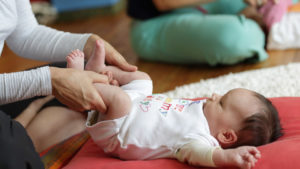
With the baby lying down on the floor or on a table, hold your baby’s lower legs and bend their legs in a gentle ‘knees to chest’ movement then release allowing them to stretch their legs out. There are positive effects of this action for easing digestion, but it is also a way to observe the baby’s reactions and respond to them: is pressure too strong? Too light? What kind of rhythm does your baby like? Getting it ‘just right’ is shown on baby’s face. As pressure on the legs is released, your baby is likely to show you the leg movements that newborns use to grow stronger, as they already did in the womb. As babies become aware of caregivers watching them exert themselves, they engage in captivating antics.


Forming a cradle with loosely bent arms to hold a newborn is a universal human act.
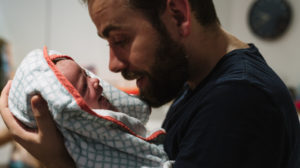
In our global culture, interactions with babies are often mediated by contraptions, gadgets and soft toys. Going back to the basics of a cradling hold with a focus on relaxing one’s shoulders and slowing down one’s breath can be a way of discovering the wonder of a shared relaxation response. The baby feels the caregiver’s relaxation, responds with relaxation through innate empathy and this in turns amplifies the caregiver’s initial actions. As an essential yoga practice, the connection experienced in this first ‘joint relaxation’ is at the same time physical, psychological and mental.


Back in 2005 I was teaching in a primary school in Tower-Hamlets. I loved teaching, but I also felt I’d left behind my teenage dream of being a massage therapist, so I went back to college to learn Indian Head Massage. At the time we (staff in my school) were researching and trying out what was termed ‘accelerated learning techniques’ – my headteacher handed me a newspaper article about the Massage in Schools Programme (MISP) and I booked myself on the training. On seeing the positive effects on my pupils and their families, I was encouraged by my MISP tutor (Sylvie Hétu) to also complete the International Association of Infant Massage (IAIM) instructor course. Infant massage was less well-known in the UK then and I wasn’t really sure what to expect, but I loved the whole concept being able to teach parents and babies massage and experience all the benefits it brings. Afterwards, I took the plunge persuading my school to let me work four, rather than five days a week, and in 2007 Buddha Baby was born!

I taught from home, and on noticing I didn’t have any refreshments available for our discussion time one week, quickly baked a cake. The clients loved it, so I did it again the following week (now I seem to be somewhat as infamous locally for my homemade cakes as for my teaching)! After a while my classes became well known, and popular with new parents in the local area. I was also starting to practise yoga. I was quite new to me and I wasn’t used to this new way of working with my body; more mindfully and less hammering the hell out of it on a Saturday morning (yes, I was the one at the front of the class with the whistle at step-aerobics)! I started to crave the feeling yoga gave me, and like many new yogis, wanted to explore this more.
A few of my clients had asked me to consider running Baby Yoga classes, and I have to be honest, I thought it just sounded a bit crazy – yoga with babies!? Singing with babies was however something I’d thought about including in my classes so I undertook training with an IAIM music specialist. At the session, someone asked about Baby Yoga training and she recommended Birthlight. As so often happens with me, something clicked, and I came home and booked the Baby Yoga training that day!
My clients often remark how calming the classes are, and how different they feel after attending. They also tell me how easy they find it to integrate Baby Yoga in their everyday lives at home, which is something I really strive for
I trained with Sally Lomas in 2011 and loved the Birthlight approach instantly. Looking back, I was so nervous to teach those few initial classes. There was lots of interest and so I just went for it, carefully planning each session and just working out what worked for me. A trainee came to observe me, she was a yoga teacher herself and I just thought she’d think ‘what are you doing teaching Baby Yoga?’ but her feedback couldn’t have been more positive, and I found confidence in myself to build upon those initial classes.
I now run regular 5-week courses in Baby Yoga for babies aged 3-7 months. I’ve learned to be more relaxed in my teaching, but have developed a basic structure for the course, which seems to suit me, and my clients well. Teaching Baby Yoga brings me so much pleasure! I look forward to my classes and the effect they have both on the parents and the babies.
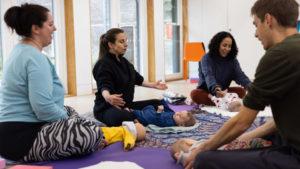
Arriving in class to everything all set out, I see frazzled parents take a sigh of relief as they settle on the mat. I love the rhythm of the Baby Yoga class; as we work through the different techniques and sequences, everyone seems to find something that appeals to them. During rest and relaxation when the whole world seems to settle, I marvel at the juxtaposition between the complexity and simplicity of a Baby Yoga session. My clients often remark how calming the classes are, and how different they feel after attending. They also tell me how easy they find it to integrate Baby Yoga in their everyday lives at home, which is something I really strive for at Buddha Baby.
I also run courses in baby massage, baby music and baby play. I am a babywearing consultant and completed my holistic massage training in 2017, so I now offer holistic well-woman massage and pregnancy massage too. I attended the diastasis recti support training day with Kirsteen Ruffell and have met many other wonderful practitioners since being a Birthlight member. During the lockdown 2020, I developed my much-loved baby-play class, based on heuristic play theory for mobile babies, and I took the online training option with Emma Philip for Birthlight Toddler Yoga. I set up some pilot Toddler Yoga classes post lockdown which went really well, but I’ve not quite got these off the ground yet due to venue availability and time in all honesty!

Alongside Buddha Baby, I’ve always worked another job, changing from full to part-time class teaching, then local authority to national advisor for primary PSHE education. I am now working freelance in my advisory role which is a bit easier to manage around my commitment to grow Buddha Baby. My current aim is to open a local yoga studio space where I can run Buddha Baby full-time. I’m considering undertaking yoga-teacher-training and I’d like to do more writing too.
When I started Buddha Baby, I thought it would be the ideal career to have as a parent, and as a woman in my early 30s, kind of just assumed I would meet someone and have children soon. It turns out Buddha Baby became my baby, and I didn’t go on to have children of my own. I sometimes find it surprising that I’ve continued on this journey, but when one of my clients asked me to contribute to a chapter in her book (Strong Mothers by Christina Morris) I reflected on my role in supporting new parents, especially mothers, and realised that perhaps for me, this is how my mother-instinct is realised.
I’ll always be grateful to my teaching degree and all the experiences of primary teaching, advising and teacher-training; it has given me such good grounding for many of the classes I offer, but yoga gave me the faith to allow small seeds to grow. To nurture those moments when you think ‘maybe I could…’ and trust that ‘yes, I can’; to be guided by my intuition and follow only what feels right to pursue.
Buddha Baby, with Baby Yoga as a key part, encompasses my passions for education, wellbeing and community. For my clients, I aim to inspire little moments of calm, connection and joy. At the heart of Buddha Baby, I truly believe that sometimes it’s the simple things that make us the happiest… a good cup of tea, a comfy cushion, a chat, a song, a smile… all of which I promise my clients they can find at Buddha Baby.

Baby Yoga Diploma starts 10th June / Baby Yoga Massage starts 7th July

The fun side of Baby Yoga was evident from the early days. Then, naively, I thought teaching Baby Yoga would be a doddle. Over time I have grown to relish the challenge of drawing on Yoga to support parents whose lives have been turned upside down by taking on the responsibility of a tiny human. Joy and humour evolve from the tales of raw truth shared by the mothers about their bodies, their emotions, their lives. Soon a camaraderie develops that forges the roots of community. When Katie, who featured in the film, wrote, ‘I couldn’t have gotten through labour or motherhood without you,’ I was transported back to the time when I first met Francoise. I went from not having a maternal bone in my body to giving birth to three children in the space of three years, a path I surely would not have taken without the inspiration of Francoise and her creation of Birthlight.
It was the mothers themselves who gently taught me how to deliver an effective session. I am still climbing that learning curve, maybe less steep nowadays. The families who were committed to the novel practice of Baby Yoga of the 1990’s in London’s Yoga Therapy Centre, witnessed their babies develop optimally in a supportive, relaxing, and enjoyable environment – then the time came to incorporate Baby Yoga for the older babies. I remember when Francoise and I patiently filled a paddling pool for the mobile babies to enjoy a sensory experience, but we did not prepare in advance for how challenging it was to empty umpteen gallons of water from a newly carpeted room on the 6th floor we occupied at The Homeopathic Hospital.


When Francoise dispatched me to deliver training to the Kids UK nursery at Amnesty International in Camden in the late 90’s, I was paddling frantically underneath my swan-like yogic exterior. Before engaging with Birthlight I lacked the confidence to tutor, but that dive into the deep end enabled me to become Birthlight’s first Baby Yoga trainer. My motivation still lies in my passionate knowledge that Baby Yoga makes a positive difference, delivering long-term benefits to new families. My early work as a Yoga Therapist has been a blessing for the holistic nature of support for my families. There is always a yogic way to nurture the mothers postnatally and enhance the mutual connection with baby. Patanjali’s Eight Limbs provide the underlying principles of this support and development. ‘Yoga is a balance’ (1), and life with a baby cannot but benefit from the injection of pockets of harmony, movement and connection into everyday life.
My eldest daughter, Aimee, featured in Francoise’s iconic first Baby Yoga book, and for a bit of fun we have attempted to recreate some of those original photos here. Soon after that publication I gave birth to twins, and as a single mum, we relocated back ‘up north’ so my mother could support our family life where she thrived as a grandmother. It was here in an area recognised for its deprivation that Children’s Centres began their first wave, and the manager invited me to introduce Baby Yoga to the local families. Yoga was quite a foreign prospect to the mothers, so when I spoke of ‘relaxation’ they took it as an invitation to enjoy a cigarette break. That is until they experienced the physical, emotional and mental balm of Yoga Nidra with baby bonding. We went on to publish ‘Yoga Birth in Words’, a collection of birth stories
Yoga was quite a foreign prospect to the mothers, so when I spoke of ‘relaxation’ they took it as an invitation to enjoy a cigarette break. That is until they experienced the physical, emotional and mental balm of Yoga Nidra with baby bonding


In those days the Children’s Centre included the services of a community midwife. She very shrewdly invited the teenage mums-to-be to McDonald’s before bringing them to my pregnancy yoga classes. They continued on to enjoy Baby Yoga and then on to encourage other young mums, one of them publishing a popular handbook for local distribution. Another group felt safe enough to share that they were suffering depression postnatally, and they went on to create a much-needed local support group. The local NHS Trust partnered with the Centre, and I enjoyed a monthly gig demonstrating Baby Yoga for a hall full of health professionals and new parents. I teamed with the Health Visitor, and the combination of Infant Massage and Baby Yoga became a constructive model of outreach support.
Nurturing the connection between mother/parent and baby with postnatal moves, infant massage and baby yoga techniques has been a process which has developed organically, a process which culminated in the creation of the Birthlight Integrated Nurturing Baby Massage and Baby Yoga blended training course.
Lasting bonds remain from the early days delivering Baby Yoga at the Yoga Biomedical Trust in Great Ormond Street. Over the years many of the mothers and their families have become loving supporters of Birthlight. Many claim that then, and now, Baby Yoga is the best class they attended with their baby. Coincidentally the Liverpool Baby Yoga film for Birthlight’s Baby Yoga Festival 2023 was filmed and edited by a former Children’s Centre Baby Yoga mother whose son is now a grown adult. Rebecca admitted that her dedication to this project was because of experiencing first-hand the benefits Birthlight Baby Yoga offers for holistic health and mental well-being.
— Written by Marion O’Connor (Birthlight Tutor)

Starts 10th June 2023

Starts 7th July 2023

Marion O’Connor started offering Baby Yoga sessions in the 90’s training and working with Françoise Freedman. She has been Tutoring with Birthlight in Baby Yoga Trainings for 25 years in many countries and different settings! Marion appeared with her daughter Aimee in Françoise’s first Baby Yoga book published in 2000.
Marion and some of the participants share a class and benefits and thoughts on Baby Yoga in this short film. These mothers and babies aged from 6 to 11 months, lovingly participated in this session which was edited by Rebecca in order to convey the essence of Marion’s Liverpool classes of Baby Yoga.
“Marion O’Connor …. has been tutoring with Birthlight in Baby Yoga trainings for 25 years”
Birthlight had the honour this year to receive an Invitation from Dr. Vikrant Singh Tomar, Global Convener of United Consciousness (www.unitedconsciousness.in). We were invited to represent the United Kingdom for the coordination series of events on the theme of G-20, called “One Earth- One Family- One Future Through Yoga”, during India’s presidency in G20 in 2023. Baby Yoga spreads joy in a simple way and it can be a profound introduction to yoga for new families. Baby Yoga promotes oneness, holistic health, and mental well-being through yoga locally and across the World.
Enjoy!

6 mornings on Weekends: 10 & 11, 17 &18th and 24 & 25th June 2023

7-9th and 14-16th July 2023
Friday 6.30-8pm, Saturday 9am -5pm, Sunday 9am -1pm both weekends

WABC has announced that Amanda Gawthorpe is the 2023 recipient of the prestigious Virginia Hunt Newman Award.
As the 2009 Award recipient, I am delighted that Amanda has been elected by an international committee that is committed to promote excellence, innovation and dedication to forward the gentle and safe introduction of babies to water and the foundations of early swimming.
Amanda’s whole life has been shaped by water since her parents, both swimming teachers, taught her to swim in the Cam river in the UK aged 2. At the time this was unprecedented. Infant Aquatics have been Amanda’s life calling and she has taught thousands of parents and babies as well as young children all over the world since the 1990s, first through Birthlight and then on her own initiative. Teaching swimming better has been and still is her life and passion.

2023 Virginia Hunt Newman International Award Honoree
to be presented September 29, 2023 at ceremonies at the
International Swimming Hall of Fame, Ft. Lauderdale, Florida USA
Virginia Hunt Newman
“The Mother of Infant Swimming”
International Award
The purpose of this annual award is to carry on
the name of Ginny Newman and her philosophy of
teaching babies to swim in a kind, loving, caring, and
gentle way so they learn to love the water !
Amanda has been a wonderful friend and colleague since she joined me to teach pioneering infant aquatics classes in Cambridge in 1992. Her original style of teaching, using games and stories and helping parents to relax, laugh and discover their babies’ and toddlers’emotions in the water deserve recognition.
Amanda has done so much for the development of Infant Aquatics. The Special Infant and Child swim club that she developed out of Birthlight classes and kept going for years every weekend has transformed many families’ lives. Some special babies became beautiful swimmers and even engaged in competition.
Amanda was the first to take GENTLE Infant Aquatics to Russia, leading a change of culture towards a kinder approach to submersion and parent-infant interactions. See Anna Shkulanova’s testimony . She inspired a new generation of Infant Aquatics teachers in Russia and remains a loved and trusted trainer. Teachers came to train with Amanda from all over Russia including countries of the former Soviet Union between 2008 and 2017.
Amanda was also the first Birthlight trainer to go and teach Infant Aquatics in China and contributed to the development of the Eureka Kids school, the first influential swim school that created franchises in main Chinese towns. After 2016, she entered a close partnership with Hi Five and worked to design and develop their Infant Aquatics programme, including a transition to early years swimming that is still missing in most Infant Aquatics programmes worldwide.

Amanda was the first to take GENTLE Infant Aquatics to Russia, leading a change of culture towards a kinder approach to submersion and parent-infant interactions. See Anna Shkulanova’s testimony. She inspired a new generation of Infant Aquatics teachers in Russia and remains a loved and trusted trainer. Teachers came to train with Amanda from all over Russia including countries of the former Soviet Union between 2008 and 2017.
Amanda was also the first Birthlight trainer to go and teach Infant Aquatics in China and contributed to the development of the Eureka Kids school, the first influential swim school that created franchises in main Chinese towns. After 2016, she entered a close partnership with Hi Five and worked to design and develop their Infant Aquatics programme, including a transition to early years swimming that is still missing in most Infant Aquatics programmes worldwide.

Amanda’s most original contribution to Infant Aquatics is her development of Toddler Swimming with playful yet effective methods, both for beginner toddlers and for toddlers in transition to unaided swimming. She has co-authored the Toddler-Early Years Aquatics training manual with Francoise Freedman. To this day, this manual stands out as being specifically directed to the 18 months to 4 years age group. The progression from toddler swimming to early independent swimming in the gap between baby swimming classes with parents and young children’s swimming classes is still an issue worldwide because ‘baby swimming’ typically stops in the second year. Then children must start again in school-aged groups. Instead, there should be continuity in early years swimming. Virginia Hunt Newman specifically tackled this challenge to increase the confidence and safety of Californian small children with a gentle approach.
Amanda embraced Water Parenting, a concept coined by Francoise Freedman to counter the dominant focus on stereotyped classes with numbered submersions in a franchise dominated industry. She always encouraged parents to ‘float relaxed’ with their babies and the videos filmed in Russia in 2014-2015 are a testimony to expressions of love in the water between Russian parents and their babies and toddlers, contrary to stereotypes of Russian culture.
In the evolution of Birthlight, ‘baby-led submersion’ was adopted as an antidote to push-pull techniques to get babies under. Amanda has played a central part in developing transitional practices to help teachers implement this new concept without contradicting their past teaching, particularly in Russia and China where performance according to parents’ expectations still rules Infant Aquatics teaching. This is a crucial contribution in the current crossroads between Gentle Infant Aquatics and survival swimming skills for babies and toddlers. Amanda has been vocal and practical in the need to develop compromises that lead to ‘child-led swimming’ rather than focus on a baby sensory approach that avoids the challenges of submersion. Playful parent submersion and teaching by imitation appealing to infants’ sense of humour have been unique strengths in Amanda’s teaching through her life. A lack of compromise risks pushing parents to Water Survival Skills, which is a great loss to everyone and misrepresents Gentle/Happy Infant Aquatics, the creation of Virginia Hunt Newman.
Warm congratulations Amanda! The world needs your heart-centred teaching or babies and toddlers in water.
With love from Francoise.

Holding and Handling Newborns
Any new parent can remember a feeling of helplessness and borderline despair when holding a new baby who cries in persistent but mysterious discomfort. Then some experienced person comes along, and the baby relaxes instantly in their calm, secure hold.
What is different? Can parents who have never held a baby before having their own learn this wonderful skill instantly? At Birthlight, our answer is YES, they can. And this learning is an essential aspect of Yoga, the art of being at one with oneself, not by retreating to a Himalayan cave, but at home in the daily routines of baby care. This is Baby Yoga.
What is relaxed holding?
Learning to hold a newborn in a relaxed way is a new and steep challenge because the change in one’s life is so sudden, and the need is NOW. Tension is natural when we feel insecure in facing the new challenges of babycare that are as physical as they are emotional and mental. What we call Baby Yoga involves an integrated bodymind state that comes with awareness of the release of tension and actively relaxing when holding your baby or anyone else’s baby. At Birthlight we call this ‘Relaxed Holding’ and we teach ways of doing this on our Nurturing Baby Massage and Baby Yoga training courses and you’ll find them in classes with teachers who trained with us. No previous visits to a yoga studio are required, nor any ability to do a sun salute or tree pose.

Responding to your baby’s crying or neediness with instant relaxation is a nonverbal way of transmitting safety and ‘I am here for you’ in a direct way to your baby. It is common and normal that a new baby’s demands may sometimes overwhelm tired parents and carers’ ability to always remain calm. You may feel yourself getting stressed out as your nervous system goes into sympathetic mode raising your heart beat. These are the moments to again and again consciously release tension and slow the breath. Gradually with practice, as your awareness grows and your attention to their breathing becomes more refined, the relaxation response can become a very beneficial habit. Babies also become attuned to this response. It is as if suddenly the world becomes safe and comfortable and all right to be in.
Once new parents embark on this journey of baby/self-discovery in interactive mode, the ups and downs of early parenting can become more exciting than daunting. Each baby is different, and each parent-baby interaction takes different forms, but growing together is eased for all by practising relaxation whilst holding your baby while babies are awake, in transition states or asleep. If you’re a bit of a perfectionist as a new parent, and like to focus on ‘doing’ by the book or if you and your baby had a difficult start it may take a little longer in remembering the ‘undoing’ of tension as a default mode. But eventually your baby’s rewarding responses will encourage you to persevere. Very simple physical yoga such as attention to the breath, letting go of tension in hands, arms, shoulders and neck, bending your knees slightly in standing to pacify a sore lower back can also create a physical ease that babies respond to.
At Birthlight, we give parents clear pointers about balance in holds, which is also an
element of yoga. Babies cannot be comfortable, and parents cannot relax if they hold their baby too high or too low. Once parents are helped to find the placement that is ‘just right’ on their bodies so that their shoulders and arms are free of tension, attention to the breath becomes easier too. As newborns respond to their parents’ positive intent to relax their holds, even if this is very tentative at first, parents begin to gain confidence not just in holding but also in handling their babies which means how to pick up babies and put them down, transfer them from one position to another in the arms of the parent and how to carry them around in an ergonomic way without a sling or baby carrier.
Infants need contact with parents’ relaxed bodies as they learn to feed, burp, and manage the complex process of digestion. Beyond the proven health benefits of skin to skin holding for premature babies, a simple application of the palm of one hand on a newborn’s tummy can be instantly calming. The skill of ‘positive touch’, that relaxes both the baby as recipient and the parent as touch-giver, is conveyed by an effortless demonstration with attention to a slow exhalation. The parent’s switch to the parasympathetic mode of the nervous system, the rest and digest, calm and connection mode, is received by the baby’s own nervous system, which is very sensitively tuned to loving carers.

In Baby Yoga, babies are the yoga gurus. If parents hold them when they have just fallen asleep, -sometimes it feels like a miracle- they can observe how the babies’ letting go triggers a relaxation response through attuning with them. It’s virtually impossible to stay tense while holding a peacefully sleeping baby. Gradually, parents register their sensations and can reproduce them while babies are transiting to sleep. Repeated experiences lead to embodied awareness and soon to the ability to produce relaxation even when babies are not easily drifting into sleep.
Baby Wearing is related to Relaxed Holds as it is now a mainstream practice in our global urban culture, with many successful adaptations of traditional local devices to carry infants attached to parents’ bodies. Thanks to Frederick Leboyer’s book “Loving Hands” (1976), infant massage practices have spread from the slums of Calcutta to the world, and research has confirmed its many benefits not only for babies but also for massaging caregivers in a touch-mediated dialogue.
Baby Yoga is, however, more general than Baby Wearing or Infant Massage, as it applies to the most basic actions in the daily routine care of newborns: lifting and lowering them from beds, cots and floors, baths; holding them in arms with soothing rhythms. Also walking around with them and securing them in car seats. In these actions, babies’ experience is blended in synaesthesia: hearing, touch, vision, and movement all in one, with an affective dimension. At the same time as babies can teach parents, they also learn the day-to-day rhythms and moods of their parents. This learning experience contributes to shape their brains. Using yoga to integrate relaxation in the early weeks and months helps parents to adopt a calmer lifestyle around their babies that facilitates parenting in return.
Following their first encounter with newborns after birth, that thankfully is receiving more importance in global maternity care, parents can use Baby Yoga to keep a spontaneously interactive direct connection with them. What Marshall Klaus called “bonding” for lack of a better word is rarely love at first sight. Nor does it emerge easily from the ‘doing’ of early baby care, following books, apps and much conflicting advice. While facing the many external demands and norms to grow a healthy baby, it is easy to forget the interconnected “holding environment” we share from day one with newborns. Taking time for ‘being’ with them and attuning with them in Relaxed Holds, as Baby Yoga, is probably the most basic ingredient of newborn wellbeing as well as the foundation of an easier, more conscious parenting.
The Psychology behind Relaxed Holding
Baby Yoga is essentially interactive. In the early months, inter-action can better be
defined as inter-being, or ‘attunement’. The British psychologist Winnicott (1945) first developed the concept of “holding environment” to describe the psychic space shared between a mother and her infant, as neither wholly psychological nor physical. Empathy with the baby encompasses holding, allowing the infant’s ego to integrate and his instincts to be fulfilled (Winnicott, 1960). Fathers now also share this intersubjective space with their newborns. For both parents, instant relaxation can diffuse difficult emotions linked with pain or unfulfilled needs, whether of their babies or their own. Holding the baby then is not just a physical act, but it includes an acknowledgement of the shared psychic space where parents and babies grow together in interaction.

Winnicot’s “holding environment” supports babies’ slow transition to self-awareness in the second half of the first year and beyond with a rather open-ended view of what was later called “co-regulation”. This is the process through which parents and infants mutually learn to navigate emotional responses in response to one another. “Containment” is similar and yet fundamentally different from holding and co-regulation. Bion’s theory of containing (1962) originates from the idea that infants project onto parents feelings that are upsetting, fearsome, painful or in some other way intolerable. Parents in turn feel the emotion themselves, but instead of reacting to it, they contain it and give it back to the infant in an adapted and contained form that can be assimilated. The end-result of emotion containment is admirable, but it requires a lot of parental self-control that may not be easily available if parents have not experienced effective containment of their own emotions in early childhood or to parents finding themselves in overly challenging circumstances or suffering from anxiety, depression or other health issues. This is where attending a group baby class can be a life changing support.
In Baby Yoga, we focus on ‘Relaxed Holds’ as a practical basis to achieve co-regulation and containment without having to understand these concepts. In the same way as swaddling can help babies whose extreme disorganised movements benefit from calming containment of limbs, we use ‘containing holds’ to create a feeling of security for the baby in their parents’ arms. Little babies love to be held in ‘cradle hold’ with parents’ arms wrapped around their bodies.
As babies open to the world in their fourth and fifth months, Relaxed Holds become freer and more adventurous to respond to babies’ greater need of movement in space. Building on the base of calming, relaxed inter-being, parents can progressively engage in more inter-acting games to their babies’ delight and their own (read more in Part 2).

See more in Françoise’s two books: Baby Yoga, Gaia Books, 2000 and Yoga for Mother and Baby, Cico Books, 2010
Next training courses:

June 2023

June 2023

July 2023
References
Winnicot, Donald. 1945. Getting to Know Your Baby London: Heinemann.
Winnicot, Donald. 1965. Maturational Processes and the Facilitating Environment: Studies in the Theory of Emotional Development. London: Hogarth Press.
Bion, Wilfred R. 1962. Learning from Experience. London: Heinemann.
Leboyer, Frderick. 1976. Loving Hands: the traditional Indian art of Infant Massage. Knopf Doubleday Publishing.

Please signup for a free Birthlight Baby Yoga session at the Baby Yoga Festival for the G20 (registration form below).
Birthlight has been the pioneer of Baby Yoga since the ’80s with books, DVDs and training courses around the world, founded by Françoise Freedman, a medical anthropologist and yoga teacher. This year Birthlight has been nominated as the UK representative for the “Yoga: One Earth, One Family, One Future” cultural event of the G20, hosted this year by India, organised by United Consciousness. Birthlight promotes Yoga to “nurture new life” from conception to 3 years and to support women’s health and wellbeing . We are also celebrating 25 years since we appeared in the Telegraph newspaper in 1998 and we are hosting Baby Yoga festivals in G20 countries and beyond. A lot has changed since then but Baby Yoga continues to bring parents and babies together in circles of mutual respect, deepening understanding and bonding.


BABY YOGA? You must be joking, how on earth can babies do yoga? Surely this is unnatural and dangerous, one of these yoga fads that discredits yoga as a reputable ancient practice brought to the West by famous Gurus after years in their Himalayan caves. Babies are not on ascetics’ radars nor even under them.
But they had mothers, sisters and perhaps daughters, women who massaged babies to help them grow strong and beautiful in a tradition going back to the dawn of humanity. In India, until recently, massage strokes and rhythmical movements akin to yoga were part of baby care in homes across social and religious divides.
At Birthlight, we have renewed the connection with the nurturing home practices in which Yoga and Ayurveda are anchored in tandem. Breath, touch, voice, relaxation in close contact develop confidence, trust and mutual understanding between parents and their new babies.
Over and above anything, in par with milk, babies need to be greeted, acknowledged, celebrated: loved on their terms.
“… but if Postnatal Yoga classes separate them from rather than connect them with their babies, something goes amiss”
— Dr. Françoise Freedman, Birthlight Founder
Baby Yoga gathers embodied practices that modernity has caused us to reject or neglect. We start with what we call ‘relaxed handling’, finding ease and comfort in the ways we hold, lift, lower, and carry babies. Installing a baby in a car seat, walking upstairs or downstairs with a babe-in-arms and even changing a nappy can be done not just mindfully but with relaxed gestures that can make all the difference, as they are repeated day in, day out.

Isn’t the purpose of yoga to develop our self-awareness so that gradually we reduce stress-building patterns, we breathe more freely, relax and sleep more deeply, are more present in our interactions? If there is one relationship that is likely to push all our buttons at once, it’s the unknown terrain of learning to care for a newborn baby. But if we let them, babies can be our best gurus, teachers of unconditional love and masters of incomparable ‘Infant Joy’ whenever we get it right.
I did not invent this. I was not taught by yogi but by Amazonian Indigenous parents whose parenting culture is one of attentive gentleness throughout the region. But I recognised the principles of yoga, and since the global urban culture most of us have babies in is open to yoga, it seemed important to get off the mat and “remember’ ancient body rhythms. We still own these rhythms, deep in our body memory. Setting these rhythms free in connection with babies is BABY YOGA.
Whether parents are in a paternal or maternal role or both, discovering and accompanying in wonderment how babies grow by attuning to them is a special privilege. Newborns show us how they continue their foetal movements after birth and use them to create their earthlings’ spinal curves. Movement integrates babies’ senses and nervous system in delight, provided it’s age appropriate. Relaxation is key to infant feeding and once babies can feed well, feeding relaxation can ease daily tasks with a restorative, energy renewing practice.
Don’t mothers need Postnatal Yoga? They certainly do, but if Postnatal Yoga classes separate from rather than connect them with their babies, something goes amiss. With a little imagination and flexibility, postnatal yoga can be inclusive and transformative with mutual benefits for mother and baby.

BABY YOGA reconnects us to the roots of Yoga. By learning to nurture the miracle of life with each new baby, we access the spring of spirituality in a humble, physical, practical way that does away with any pretence and self-delusion. Day by day, babies smile more, showing us how we are on the path.

Birthlight Tutor & Founder
Dr Françoise Freedman is the Founder and Director of Birthlight. She is a pioneer, Senior Yoga Teacher, acclaimed writer and lecturer of Social Anthropology at the University of Cambridge. More>>