Once upon a time, not so long ago, yoga for pregnancy was considered to be dangerous. Birth preparation programs that included exercise were sensational media material. Fathers were still pacing in the corridors of maternity hospitals smoking proverbial cigars. If they were admitted on delivery units, they stood nervously behind doctors and midwives and were known to faint. Actually, this was only forty years ago in most parts of the UK…
In the meantime, yoga took over the world as a mind-body practice with clear beneficial applications for pregnancy, birth and the postnatal period. I feel privileged and happy to have been one of the pioneers of yoga towards a better experience of maternity and early parenting, not only for pregnant women but also for their birth partners. The greatest change is that a shared experience of pregnancy, birth and beyond, with fathers seeking an active involvement from the first baby scans, is now normal. While safe adaptations of Asanas during pregnancy were the main focus in early yoga programs, at Birthlight classes at the Yoga Therapy Centre in London, we gave priority to Pranayama, relaxation, meditation, visualization, mudra and affirmation in a holistic support that included fathers in monthly yoga sessions. Doing yoga together, couples developed a true body-based communication that served them well during labour, whether fathers were intimately involved in the birth process or exceptionally, became empowered to voice their preference for non-attendance. The fundamental principles of Yoga, Ahimsa (Non-violence), Sattva (Truth) and Namaste (Respect for the person) come into full play at this time of extreme transition in the lives of all involved: the parents, the babies (in bumps and in cots), close family and friends.
Yoga for birth partners is far more than birth rehearsals with a yoga flavor. It is a jointly transformative partner practice that accompanies and supports parents-to-be through their discovery of who they are becoming, in their relationship and as individuals, as they face challenges at every stage of the reproductive process. Traditional cultures have powerful parenting rituals such as “couvade” (literally “brooding”) that may involve fathers from pregnancy to baby-weaning. Yoga can take a substitute role in our global culture. As the crucial importance of emotional security and its long -erm effects for both fetuses and new parents is better understood, practices of joint yoga breathing and Nada Yoga (sound) are likely to gain center-stage in yoga for pregnancy and birth. New parents can use them as invaluable calming resources in the turbulent phase of the postpartum as newborns have vivid fetal memories of their parents’ joint yoga.
Let us not forget the value of fun and enjoyment of the present moment. This is perhaps the greatest life lesson new babies bring to their parents. Interactive yoga can be playful and dynamic, helping to release tensions and even latent conflicts in a light physical way. Many Asana can be adapted with isotonic presses that build muscles and resilience. For example, flow warrior poses in pairs reveal the unsuspected power of pregnant women. Utkasana, understood as a semi-squat with spinal extension, helps both partners to have flexible knees while toning their sacral nervous plexus. Partner yoga expand into oxytocin releasing yoga walks and yoga dance pioneered by Birthlight since the 1990s. Rather than singling dance as a pre-labour practice, why not include steps early on in yoga classes for the delight of couples? The beautiful carvings and statues of South Asian temples are not only showing erotic couples. They are also an inspiration of how the transition to parenting can be lived with yoga. No one will deny that birth is painful and sometimes an ordeal. But having a baby is part of Ananda, the joy in the universe
that we most need to be attuned to at this time.

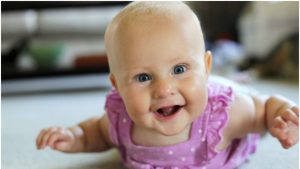
Tummy Time helps me develop strong lower back muscles and good head control after birth, but I need you to be involved. Please join me on the floor so we can have fun doing yoga together. I like your cobra pose but watch, I can do it without arms! Recent research is showing how vision and movement together are key to my brain development. I am programmed to grow, but it’s not just a bunch of reflexes. I am really doing this with you…As I watch you, an image is formed in my brain that makes me create movement with my body. Scientists have called this ‘ideokinesis’. I am glad you have understood that I have a great sense of humour, even if I am so little… If movement comes with a game, or a rhythm we can share, this is most enjoyable for me. I know you love my smiles and giggles, and I love your smiles to me in return.
After I have been sleeping on my back or been in the car seat, please turn me around and do interactive Tummy Time with Baby Yoga after changing my nappy! I can nearly roll over by myself, it will happen soon and then we will have a new set of games to play together.
And when we go visiting friends, don’t forget to hold me in the Birthlight ‘secure front hold’ so that I can greet them. This is different from Tummy Time, but it also strengthens my back and neck. Now that I am bigger and can hold my head better, I want to see the whole wide world from the safety of your arms.
Related Links:

From the beginning, all Birthlight activities have been in circles, both on land and in water.
Circles integrate teacher and students as equals. Teachers are leaders, who stand among their students rather than standing opposite them. This creates empathy and participation all around.
In circles, we are connected but we also have our own personal awareness in space.
We are all drawn to a central point but at any time we relate to our neighbours or to people opposite or diagonal to us. Circles feel warm. In circles, we can belong without being overwhelmed or threatened. We can choose how we take part. We can be more active and expressive, or quieter in our participation while all the time being fully involved.
Circles invite movement. Circles ARE movement. They are the primal form of tribal dance, as lines join and separate to create and dissolve circles in set rhythms, slow or fast, fluid or stomping. Chanting and dancing in circles are hypnotic practices that free our body-minds from their habitual patterns. Across world cultures, they are used to renew our connection with the earth, the spirit world, origins, the depth of our beings.
Even when sitting still in a circle group meditation, subtle waves are created as everyone finds relaxed positions. Breathing starts to become synchronised, ‘entrained’ from one person to the other. The collective energy of the circle supports each of us as individuals in a present moment of togetherness. ‘Movement in stillnes
Water, as a cohesive medium, deepens the feelings of friendliness and compassion we experience in circles. Oxytocin flows freely in aquatic circles of pregnant women and parents with babies. In water, waves, currents and counter-currents make Birthlight circles dynamic, both calming and uplifting. Whether we have our feet on pool floors or float together, the circular forms we create together are like mandalas, fleeting but deeply felt expressions of finding our centre in the world.
Birthlight teaching circles are intended to open and expand into spirals of group and personal transformation as we grow through life’s cycles. From conception to birth and beyond; from birth to the early years; from the portal of birth to the portal of menopause.
Circles and spirals, the forms of life growth on our planet earth, are inscribed in our bodies in many mysterious cycles that ancient religions sought to understand and map. When we create human circles, we enter more easily the cyclical time of myths and dreaming that our linear perceptions tend to hide. If we picture humans’ and earth’s evolution as an ever–expanding spiral of joy and wellbeing, then the embodiment of these forms is more than symbolic. It is truly life affirming.
During the Covid19 pandemic, geographical distance and isolation have interrupted our ongoing Birthlight circles of face to face local group practice. Yet, technology can facilitate the structuring principle of our circles. As we are drawn into virtual circles through our screens, connection can be nurtured both with people we already know and with others who join in. The ripple effects of these different circles of practice also create community as we each continue to integrate them in our home spaces, extending to the myriads of connection that we call ourselves. Online, the central points of our circles are less easy to grasp, but group practices of yoga are effective to help us all remain grounded where we are in unity, in the same way as voices in virtual choirs join to create wonderful music.