
Most conversations about the pelvic floor begin — and end — in the same place: pregnancy, birth, postpartum and the instruction to do your Kegels. But your pelvic floor is with you for life. It quietly shifts and adapts through every hormonal change, every physical transition, every decade you live in your body. And when we start to understand it that way — as a lifelong companion rather than a postnatal afterthought — everything changes.
In Ayurveda and the yogic tradition, the energy that governs the pelvic floor is known as Apana Vayu — the downward-moving current of life force, seated in the pelvic cavity. Apana governs all the body’s processes of release and letting go: elimination, menstruation, childbirth, and the deep exhale that comes with genuine relaxation. Its function is not just physical but emotional too — the capacity to release what no longer serves us, to surrender and trust rather than grip and hold. This is a profoundly feminine energy, and it is a thread we will return to throughout this piece. Because what the research and the ancient wisdom traditions seem to agree on is this: a healthy pelvic floor is not about gripping harder. It is about knowing when — and how — to let go.
Here is what we actually know about what is happening in the pelvic floor at each stage of a woman’s life.
It starts earlier than you think: Puberty and the teenage years
Most people assume pelvic floor difficulties are something you encounter after having a baby. But the story starts much sooner.
During puberty, the female pelvis undergoes a significant structural reshaping, driven by rising oestrogen. Something that surprises many people: this process doesn’t fully complete until a woman’s mid-to-late twenties. The pelvis is still evolving well into early adulthood. And because oestrogen receptors are woven throughout the muscles and connective tissues of the pelvic floor, every major hormonal shift in a woman’s life — from puberty onwards — will register there in some way.
Research has found that pelvic floor difficulties are not exclusively a postnatal or menopausal experience. Urinary leakage affects a meaningful proportion of teenage girls and young women who have never been pregnant. A systematic review covering thousands of women found that knowledge about the pelvic floor is generally low across all age groups — with adolescents among the least informed, and most reporting that pelvic floor health was never discussed at school (Moura Ramos et al., 2023).
A note on young athletes: strength is not the whole story

This is where the picture becomes more complex, and considerably more interesting, for anyone working with active young women.
We might assume that girls who play sport regularly are at an advantage when it comes to pelvic floor health — stronger muscles, better body awareness, more physical conditioning. And in some ways, for some sports, there are benefits. But research tells a more nuanced story.
High-impact sports — those involving a lot of running, jumping, and landing — place repeated and significant load on the pelvic floor with every ground contact. Studies have found that urinary leakage affects between 26% and 80% of female athletes depending on the sport, with the highest rates found in trampolining, gymnastics, volleyball, handball, and distance running (systematic review, Saudi Medical Horizons Journal, 2025). In one large survey, stress incontinence was reported by 37% of triathletes and 50% of volleyball players — the majority of whom had never given birth (Louis-Charles et al., Current Sports Medicine Reports, 2019).
Two competing theories explain this. The first is that intense training can build greater pelvic floor muscle strength — but that even this apparent advantage does not always translate into continence, because strength without coordination and the ability to release is not enough. The second is that repeated high-impact loading over years can actually overload the pelvic floor and its connective tissues, leading to structural changes that increase vulnerability to dysfunction (Pan et al., 2025). In other words: a very trained, apparently ‘strong’ pelvic floor can be just as problematic as a weak one, if it is chronically loaded and has never learned to fully let go.
When the body braces: Stress, anxiety, and trauma
Perhaps the most underacknowledged influence on pelvic floor function is also one of the most pervasive: the state of the nervous system.
The pelvic floor is not just a group of muscles. It is part of a deeply intelligent protective system, and it responds to perceived threat — whether physical or emotional — by contracting. This is known as the pelvic stress reflex: when the nervous system shifts into fight-or-flight mode, the pelvic floor is among the first muscle groups to engage (Physiopedia, 2024; Anchor Pelvic PT, 2024). In short-term, genuine emergencies, this is adaptive. But in a body that is living with chronic stress, anxiety, or the aftermath of trauma, this reflex never really switches off. The pelvic floor stays braced, quietly holding, long after the stressor has passed.
What does this look like in practice? Chronic stress — the kind that comes from overwork, poor sleep, financial pressure, relationship difficulty, or simply the relentless pace of modern life — keeps cortisol elevated in the body for hours at a time. Prolonged cortisol exposure contributes to sustained muscle tension, and the pelvic floor is particularly susceptible, sitting as it does at the physical and emotional centre of the body (Physiopedia, 2024). Women living with high stress often report symptoms that are not obviously ‘pelvic’ in origin: difficulty fully emptying the bladder, urgency, constipation, a general sense of tightness or heaviness in the pelvis, or pain that seems to wax and wane with their stress levels. Research from Monash University has found that people with irritable bowel syndrome — a condition closely linked to pelvic floor tension — are three times more likely to have anxiety or depression, and that the more severe the psychological distress, the more severe the bowel symptoms (Sydney Pelvic Clinic, 2024).
The question that clinicians sometimes ask is a difficult but honest one: which comes first — the pelvic dysfunction, or the anxiety? The answer, increasingly, appears to be that they feed each other. Pain and dysfunction heighten anxiety; anxiety tightens the pelvic floor further; a tighter, more dysfunctional pelvic floor produces more symptoms; and the cycle continues. Breaking it requires attending to both dimensions at once.
Trauma adds another layer of complexity — and sensitivity. The pelvic floor is deeply connected to our sense of safety, bodily autonomy, and personal boundaries. When a woman has experienced trauma — whether that is a difficult or frightening birth, a medical procedure that felt violating, sexual trauma, or any experience in which the body felt threatened and helpless — the pelvic floor may hold the imprint of that experience long after conscious memory has moved on. Research published in the European Journal of Psychotraumatology found that women with PTSD symptoms demonstrated significantly higher pelvic floor muscle activity than those without, and that greater PTSD severity was directly associated with greater pelvic floor overactivity (Karsten et al., 2020). Symptoms of hypervigilance and nightmares were particularly associated with elevated pelvic floor tension. Significant correlations have also been found between a history of sexual trauma, subsequent PTSD, and chronic pelvic pain (Herman & Wallace Pelvic Rehabilitation, 2024).
It is important to say clearly: a tense pelvic floor in the context of trauma is not dysfunction. It is protection. The body is doing exactly what it has learned to do to keep a person safe. The clinical and therapeutic challenge is not to override or force that protection away, but to gradually and gently help the nervous system learn that it is safe enough to soften — to experience, perhaps for the first time in a long while, what it feels like to release.
Trauma can show up in the pelvic floor in different ways. Some women experience overactive, tight muscles. Others experience what looks like the opposite — numbness, disconnection, or an inability to feel the pelvic floor at all — which can reflect the nervous system’s response of withdrawal or shutdown rather than bracing (Empowered Pelvic Health, 2025). Both patterns reflect the body’s wisdom under difficult circumstances. Both need a different approach from the standard ‘strengthen your pelvic floor’ prescription.
This is the territory where Apana Vayu speaks most profoundly. In Ayurvedic understanding, when Apana is disturbed — held under pressure, unable to flow, forced inward rather than allowed its natural downward movement — the consequences are felt throughout the whole pelvic bowl: pain, retention, tightness, a sense of being unable to release or let go. Restoring Apana in this context is not a physical exercise. It is a return to safety. It is creating the internal conditions — through breath, through gentle movement, through the felt sense of the body being held rather than threatened — in which the pelvic floor can dare to soften. Yoga, with its emphasis on both the regulation of the nervous system and the cultivation of interoceptive awareness, is uniquely placed to support this process.
For yoga teachers and therapists working in this space, a trauma-informed approach is not optional — it is essential. This means never assuming that the body’s tightness is simply a training deficit. It means creating an environment of genuine safety before asking anything of the pelvic floor. It means understanding that helping a woman reconnect with this part of her body, after years of holding, bracing, or simply not feeling it at all, may be one of the most significant things a yoga practice can offer.
The childbearing years: pregnancy and what comes after
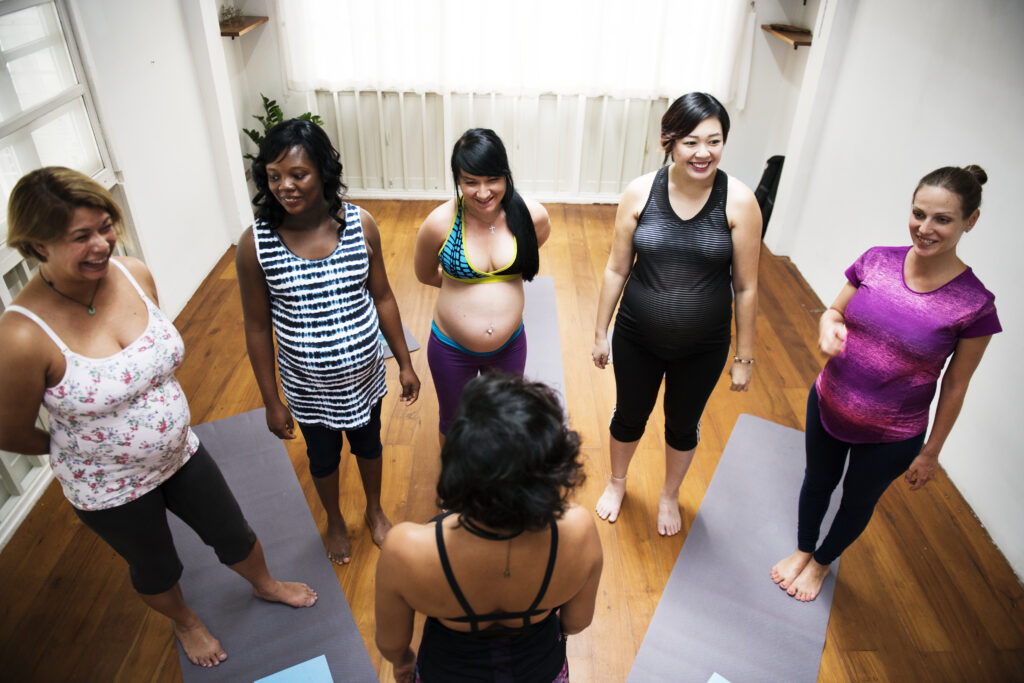
Pregnancy is rightly understood as a significant time of change for the pelvic floor — but the full picture is considerably more nuanced than ‘vaginal birth causes damage.’
The pelvic floor begins adapting from the very first trimester, well before any birth takes place. Hormonal changes, particularly the effects of relaxin on the connective tissues, alter the way the pelvic floor muscles and fascia behave. Studies using 3D ultrasound imaging have tracked these structural changes progressing through each trimester. These changes are largely purposeful and adaptive — an expression, in many ways, of Apana Vayu naturally preparing the body for the most profound act of release a woman can undergo. But they also mean that pregnancy itself, regardless of how birth ultimately unfolds, places real demands on the pelvic floor.
It is also worth remembering here that a woman who arrives at pregnancy carrying chronic stress, anxiety, or unresolved trauma in her pelvic floor — whether from sport, from life experience, or from her own nervous system’s history of bracing — arrives with a pelvic floor that may already need support quite different from basic strengthening. A pelvic floor preparing for birth needs above all to be able to release.
This matters because of a persistent myth that has caused real harm: the idea that having a Caesarean section fully protects pelvic floor function. Research has significantly complicated this picture. Studies have found that women who delivered by C-section still showed measurable changes to pelvic organ support when compared with women who had never given birth — suggesting that the pregnancy itself, not only the birth, reshapes the pelvic floor (Pan et al., 2025). A Spanish study found that roughly half of all first-time mothers reported some form of pelvic floor difficulty in the five to ten years following their first delivery, whether that birth was vaginal or by Caesarean section (González-Timoneda et al., 2025).
And yet the postnatal support available to most women in the UK falls dramatically short of what is needed. A Dutch qualitative study found that women with postnatal pelvic floor difficulties were largely uninformed about what was happening in their bodies and given the impression that things would simply resolve on their own (Buurman & Lagro-Janssen, 2013). The unresolved postnatal pelvic floor does not tend to simply disappear. It often reappears — frequently more intensely — when oestrogen levels begin to fluctuate during perimenopause.
The stage no one warns you about: Perimenopause
If postnatal care is underprovided, perimenopause is arguably where women feel most blindsided. The hormonal fluctuation that characterises this transition can begin in a woman’s early forties — sometimes earlier — yet most women arrive at it with very little understanding of what it means for their bodies.
As oestrogen levels begin to decline, the effects are felt not just in muscle strength but in tissue elasticity, collagen levels, and blood supply throughout the whole pelvic area. One study of perimenopausal women found a meaningful connection between pelvic floor function and sexual wellbeing — those experiencing pelvic floor difficulties had significantly lower scores for libido, sexual satisfaction, and orgasm (Pu et al., 2022). These are not peripheral concerns. They go to the heart of how women feel in their bodies during one of the most significant transitions of their lives.
It is also worth knowing that a tight pelvic floor is not necessarily a strong or healthy one. As we age, pelvic floor muscles can become denser and less flexible even as their functional capacity declines. The reflex response of ‘squeeze harder’ doesn’t address this — and can actually make things worse. What is needed at this stage is coordination, awareness, and the full capacity to both engage and release.
For women who have spent years managing chronic stress, or who carry unresolved holding patterns in the pelvic floor from earlier life experience, perimenopause can be the moment when those patterns become impossible to ignore. The hormonal changes of this transition reduce the body’s natural buffers, and what was previously just manageable may now announce itself more loudly.
From an Ayurvedic perspective, this makes complete sense. When Apana Vayu is disturbed — whether depleted through hormonal shifts, or obstructed by years of chronic holding — the symptoms that follow include exactly what women report most commonly at this stage: urinary urgency and leakage, difficulty with elimination, pelvic heaviness, pain, and a sense of disconnection from the lower body. Restoring the flow of Apana means not simply strengthening what has weakened, but softening what has tightened, and reconnecting with the body’s natural intelligence around release.
Later life: the long view
The picture in post-menopausal women is, in many ways, the cumulative result of everything that has come before — the structural legacy of any births, the hormonal transition of perimenopause, habitual posture and movement patterns built up over decades, the long-term effects of stress on muscle tone and connective tissue, and the natural ageing of the body’s tissues.
A landmark framework developed at the University of Michigan — known as the Lifespan Model for Pelvic Floor Disorders — describes pelvic floor health as a kind of reserve built during early life and gradually drawn upon over time (DeLancey et al., 2008). Some women will never reach a symptom threshold across their whole lifespan, while others — depending on genetics, birth experiences, athletic history, stress load, trauma history, and lifestyle — will notice symptoms emerging earlier or more significantly. This helps explain why pelvic floor difficulties vary so enormously between women of the same age.
Importantly, that same body of research affirms that it is never too late for the pelvic floor to respond to intelligent, consistent movement practice. The key is that what is offered must fit the physiology and the history of that particular woman — not a generic prescription designed for a younger body, or a simpler set of circumstances.
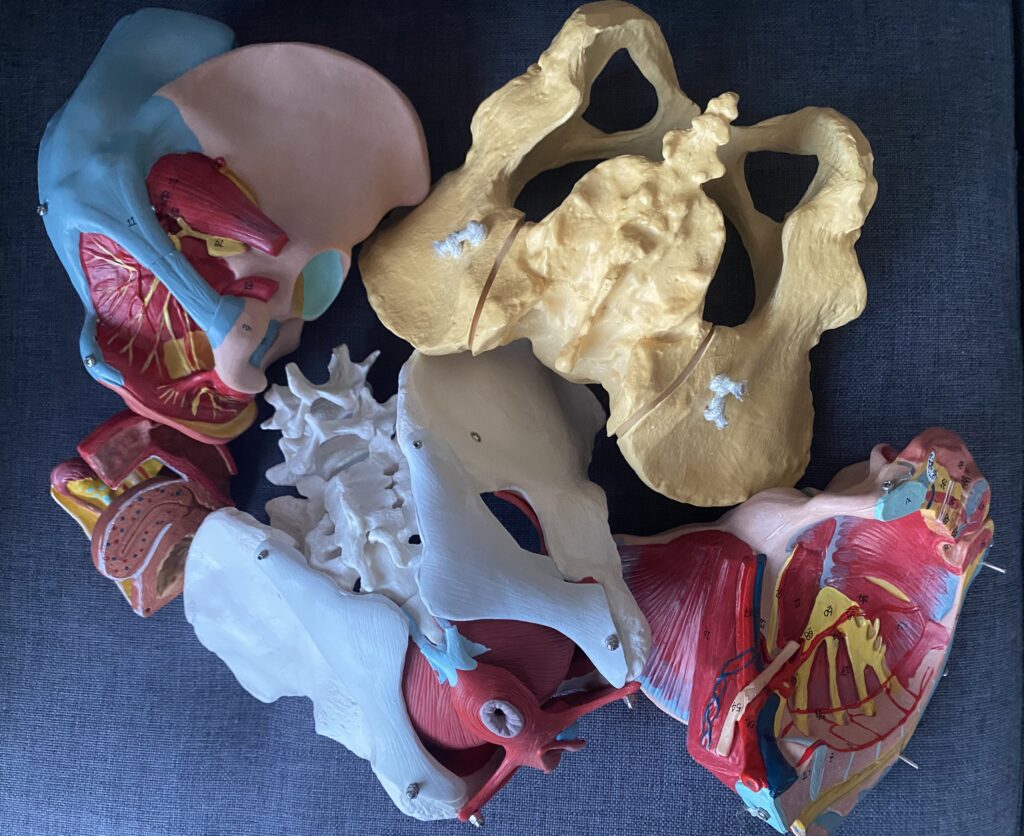
The gap no one is filling
Perhaps the most striking thing across all of this research is how poorly informed women are at every stage. A Dutch study found that around three quarters of younger women and two thirds of postmenopausal women felt insufficiently informed about pelvic floor health, and that most postmenopausal women received their first real information about it during the postmenopausal period itself — far too late for any preventive benefit (Wiegersma et al., 2016). In response to evidence like this, NICE published a guideline in 2021 specifically recommending that girls aged 12–17 receive pelvic floor education in school settings, and that older women should be given information during perimenopause and menopause conversations in primary care.
The taboo around talking about pelvic floor experiences — the leaking, the heaviness, the pressure, the discomfort during intimacy, the sense of something not quite being right — keeps many women isolated with symptoms they have been led to believe are simply part of getting older, having had children, or having pushed their bodies hard in sport. They are not inevitable. And they are rarely just physical.
Therapeutic yoga offers something that standard pelvic floor programmes rarely provide: a whole-person approach that attends to coordination and elasticity, not just strength; to breath and posture; to the nervous system and its history; and to the embodied experience of where the pelvic floor is and what it actually feels like — from the inside. These are the factors that determine how a pelvic floor actually functions in real life, across every stage of the lifecycle and every variety of lived experience.
And running through all of it, quietly, is that ancient understanding of Apana Vayu: that health in the pelvic bowl is not about holding on. It is about the capacity to hold and to let go — at the right time, with awareness, in a body that feels safe enough to do both.
That, perhaps, is the deepest aim of therapeutic yoga for the pelvic floor. Not to train the muscles harder, but to restore a woman’s relationship with her own body’s intelligence. To help her feel, from the inside, what it means to be truly at home in her pelvic floor — across every stage of her life, and through everything that life has asked of her.
This post was written in the context of our upcoming CPD workshop: Yoga for a Healthy Pelvic Floor through Women’s Lifecycles. The workshop is open to yoga teachers, yoga therapists, and women who wish to deepen their own embodied understanding of pelvic floor health.
A note on the research and where it comes from
Most of the research informing our understanding of the pelvic floor across the lifecycle comes from the USA, the Netherlands, Scandinavia, and Spain — not the UK. The influential Lifespan Model (DeLancey et al.) was developed at the University of Michigan. The Dutch and Scandinavian studies are frequently cited in UK clinical guidelines, partly because those countries have considerably more established systems of pelvic floor physiotherapy within routine women’s healthcare than the UK currently does. The research on stress and trauma draws largely on North American clinical settings. The perimenopause and sexual function study (Pu et al.) carries its own Chinese cultural context around disclosure and help-seeking that differs from a UK setting.
The 2021 NICE guideline on pelvic floor dysfunction prevention is the most directly UK-relevant source — and the fact that it needed to recommend pelvic floor education for schoolgirls, and routine conversations in primary care, tells us something important about the size of the gap between what is known and what women in the UK are actually offered.
Key References
- Buurman, M.B.M. & Lagro-Janssen, A.L.M. (2013). Women’s perception of postpartum pelvic floor dysfunction and their help-seeking behaviour. Scandinavian Journal of Caring Sciences. [Netherlands]
- DeLancey, J.O.L. et al. (2008). Graphic integration of causal factors of pelvic floor disorders: an integrated lifespan model. American Journal of Obstetrics and Gynecology, 199(6). [USA]
- Eliasson, K., Lasson, T. & Mattsson, E. (2002). Prevalence of stress incontinence in nulliparous elite trampolinists. Scandinavian Journal of Medicine and Science in Sports. [Sweden]
- González-Timoneda, A. et al. (2025). Prevalence and impact of pelvic floor dysfunctions on quality of life in women 5–10 years after their first vaginal or caesarean delivery. Heliyon. [Spain]
- Karsten, M.D.A. et al. (2020). Sexual function and pelvic floor activity in women: the role of traumatic events and PTSD symptoms. European Journal of Psychotraumatology. [Netherlands]
- Louis-Charles, K. et al. (2019). Pelvic floor dysfunction in the female athlete. Current Sports Medicine Reports, 18(2). [USA]
- Moura Ramos et al. (2023). Do women have adequate knowledge about pelvic floor dysfunctions? A systematic review. PMC. [International/multi-country]
- NICE (2021). Pelvic floor dysfunction: prevention and non-surgical management. NICE guideline NG210. [UK]
- Pan, J. et al. (2025). The impact of pregnancy and mode of delivery on female pelvic floor function: a narrative review. Clinical and Experimental Obstetrics and Gynaecology. [International]
- Physiopedia (2024). Impact of stress and cortisol levels on pelvic pain and pelvic stress reflex response. physio-pedia.com [International clinical resource]
- Pu, D. et al. (2022). The relationship between pelvic floor function and sexual function in perimenopausal women. PMC. [China — note cultural context]
- Saudi Medical Horizons Journal (2025). Pelvic floor dysfunction in young females associated with high-impact physical activity: prevalence, risk factors, and preventive interventions — a systematic review. [International]
- Siqueira-Campos, V.M.E. et al. (2019). Anxiety and depression in women with and without chronic pelvic pain: prevalence and associated factors. Journal of Pain Research. [Brazil]
- Wiegersma, M. et al. (2016). Knowledge of the pelvic floor in menopausal women and in peripartum women. Journal of Physical Therapy Science, 28(6). [Netherlands]